This CIP proposes to further reduce Celestia’s inflation rate from 5% to 2.5% and increase the minimum validator commission from 5% to 10% in the next major upgrade (v5). These changes aim to make TIA more suitable for financial applications by reducing the opportunity cost of using TIA as collateral or in DeFi protocols, while ensuring validators remain adequately compensated for their services. The proposal builds upon CIP-29 which previously reduced inflation by 33%, and maintains the same disinflation rate of 6.7% annually.
3 Likes
As a validator, we fully support this proposal
2 Likes
TL;DR - Directionally correct move that we support in the immediate term, but we believe PoG remains the clearest path to durable, value-accretive token economics.
These are our high-level takeaways:
• Issuance Implications: Halving base inflation from 5% to 2.5% removes ~29m of new TIA tokens each year and trims eight-year issuance by ~220m TIA, bringing the 1.5% terminal inflation rate forward by a full decade.
• Validator economics: Raising the commission floor to 10% lifts the stake-weighted fee from 14.2% to 16.5%
54 validators (~55% of stake) must adjust, shifting about 0.7m TIA per year from delegators to operators, small on a network-wide basis, but meaningful as rewards shrink.
• PoG Remains the Optimal Economic Path: In our opinion while this is a directionally correct move for issuance policy, PoG’s 0.25% inflation track still dominates on long-term scarcity.
Over eight years it mints about eight-times fewer TIA than the newly proposed schedule, pushing the network close to neutral issuance while leaving headroom for DA-fee growth and other potential avenues to do the heavy lifting.
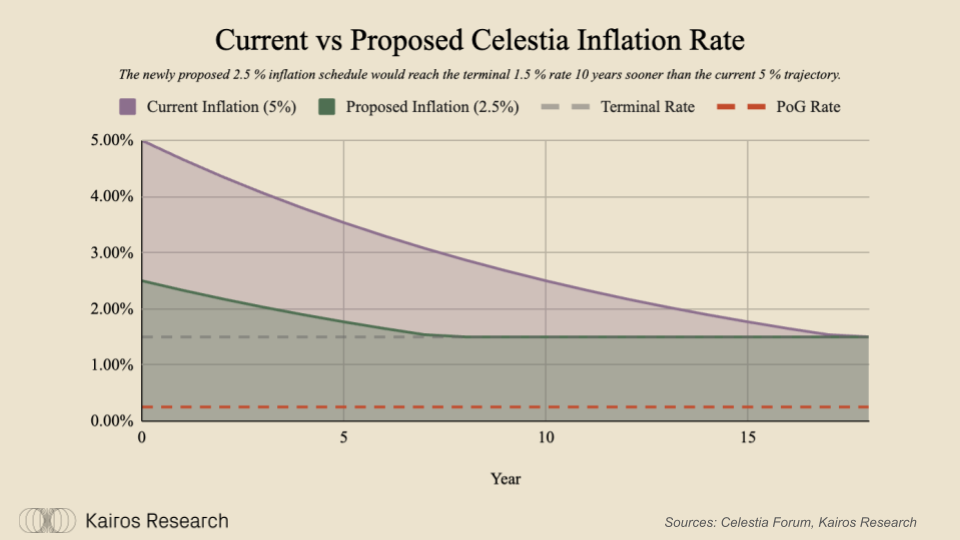
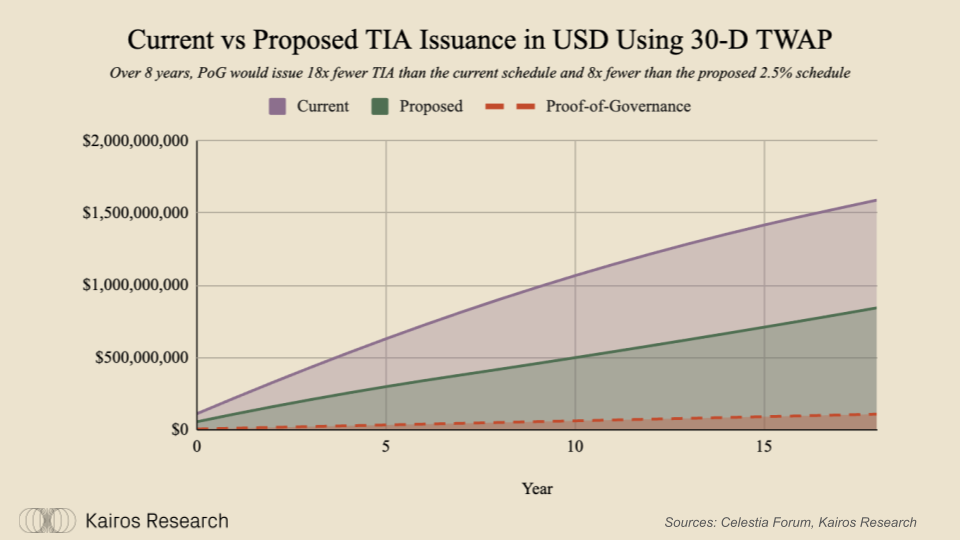
We believe PoG remains the clearest path to durable, value-accretive token economics.
6 Likes
Currently, a validator earns approximately $4,108 per month with a 10% commission, 3 million TIA delegated, a token price of $1.6, and an APR of 10.27%. We are aware that in the coming month, 43.5 million TIA purchased from Polychain will return to staking, which will increase the staking ratio to ~51.4% and reduce the APR to ~9.72%, bringing validator earnings down to approximately $3,888 per month.
Validators must cover the costs of bare-metal servers, monitoring systems, IBC relayers, backup nodes, alerting systems, key management, and security infrastructure. To maintain decentralization, many operators choose to run infrastructure in geographically diverse and less common data centers, which significantly increases expenses. At current levels, profitability is already near the margin.
If the inflation is reduced to 2.5%, with the same staking ratio, the APR would drop to ~4.86%, resulting in validator income of only ~$1,944 per month — half the current level. In such conditions, many validators will be forced to abandon high-quality infrastructure in favor of cheaper cloud setups, which could compromise the reliability and decentralization of the network.
Furthermore, in the recent forum discussion Proof of Governance as the endgame for LSTs, adlerjohn emphasizes the importance of maintaining validator incentives, as a key factor in ensuring network security. Sustaining adequate validator income is not just an economic issue — it’s fundamental to the security and robustness of consensus.
Reducing inflation month after month is not a sustainable strategy. It might make sense under different market conditions, but certainly not right now, when the network is still growing and infrastructure costs remain high. We believe this proposal does not represent an improvement and that changes to inflation must be considered more cautiously, with long-term validator sustainability in mind.
As a validator, Polkachu fully supports this proposal. LFG!
Thanks for voicing your concerns. They’re totally valid and there have been a lot of discussions elsewhere about how to strike that fine balance that encourages a strong validator set i.e. one that is reliable (geographically and infra diverse) and can sustain high throughput (sufficiently beefy machines) yet can expand the utility of the token beyond just DA and keep competitive pricing even as demand increases.
The actions proposed here are part of a longer term plan to move away from depending on inflation as a means of validator revenue and towards fees; to moving away towards an inflationary token to one that is more stable and can thus be used by rollups and their services with little opportunity cost or reliance on liquid staking.
At the same time, we’ve been looking at the other half of the equation, which is reducing the cost on validators to provide high quality DA. We conducted a survey recently to better understand node operator costs and have proposed a few ideas to reduce them including CIPs 34, 36 and 37 which are aimed at reducing the amount of storage node operators need to allocate along with further designs to deduplicate some of the storage between consensus and bridge nodes.
If we notice that these changes aren’t sufficient for node operators to sustain their operations, then we can review further changes such as increasing the commission rate again. I wouldn’t advocate printing more tokens as a sustainable means of compensating validators.
We fully agree that printing additional tokens is not a sustainable or desirable long-term solution for validator compensation. Likewise, moving towards a model where validator revenue comes more from fees and less from inflation is the right strategic direction for the network’s maturity and token stability.
However, the current proposal to reduce inflation is not a cure-all at this stage. While the long-term benefits for token utility are clear, the immediate effect under current market and staking conditions would be a significant drop in validator revenue. As our earlier calculations show, with the return of 43.5M TIA to staking and a halving of inflation, most validators receiving delegations from the Foundation will see their profits eliminated entirely — especially those who invest in maintaining decentralization, providing community services and products, and operating additional infrastructure critical to the ecosystem. This will inevitably impact infrastructure quality and network decentralization.
We believe that reducing inflation is indeed the right step, but only after we ensure that validators have sufficient incentives to continue providing high-quality DA services. This means:
• Completing work on cost-reduction measures (CIPs 34, 36, 37 and others) and confirming their real-world impact.
• Exploring mechanisms that could sustain validator incentives during the transition (e.g., minimum commission rates, targeted delegation programs, or performance-based rewards).
• Monitoring the network’s health metrics to ensure that validator diversity and throughput remain unaffected.
In short — the end goal of a low-inflation, fee-driven model is correct, but the sequence matters. Cutting inflation first and addressing incentives later could put the network at unnecessary risk. The better path is to secure validator sustainability before making the next inflation reduction.
I think the right approach here for validators receiving a delegation from the foundation, would be to advocate for loosening the requirements from the Foundation delegation program (e.g. dropping archival nodes as a requirement). That way, validators can easily remain profitable without maintaining the current (still too high) inflation. This requires careful considerations on how have sufficient archival (consensus/state/DA) nodes in the network still. This and cost reductions will make things work and more sustainable for validators in the long run as well.
we support this proposal. This is a net positive for the ecosystem.
1 Like
Am I correct in understanding that validators participating in the delegation program are no longer required to run archive nodes for their bridges? It also sounds quite strange to hear that you are now “carefully considering” how to maintain a sufficient number of archive nodes, after having already made the decision to cut inflation in half. Perhaps it would have made more sense to think this through first and only then make such a drastic cut to inflation? Will there be any additional incentive measures?
I believe you will see widespread complaints from validators starting with version v6, since it is hardly as “easy to maintain profitability” as you say. No one will keep archive nodes running, validators will shift to more common locations and cheaper hardware, especially since you have already raised CPU requirements.
The bottom line is this: you are reducing validator revenue by half through the inflation cut, you claim that removing archive node requirements somehow offsets those losses (which it clearly does not), and at the same time you are increasing CPU requirements, which raises server costs. I do understand the reasoning behind lowering inflation, and it is indeed a noble goal, but the question of validator support has not been addressed at all. I think that after the v6 upgrade many validators, who are currently hesitant to voice their concerns, will suddenly appear with their complaints. Excellent work, Celestia team — see you after the upgrade.
This is already being rolled out (first with the reduction of the sampling window and then the pruning window) and should be completed before the next major version (that would bring about the modification to inflation).
The bottom line is this: you are reducing validator revenue by half through the inflation cut, you claim that removing archive node requirements somehow offsets those losses (which it clearly does not), and at the same time you are increasing CPU requirements, which raises server costs.
As I mentioned in the CIP, it was proposed to increase the minimum commission rate to offset what reduction in revenue would have occurred with reducing issuance. Do you propose that the minimum commission rate should be in fact increased more? At the moment most of the revenue generated by the protocol goes towards delegators for picking the validator set. We’d instead like to move to a world where most of the revenue goes to the validators for providing the service (this is where all the PoG discussions revolve around)
1 Like