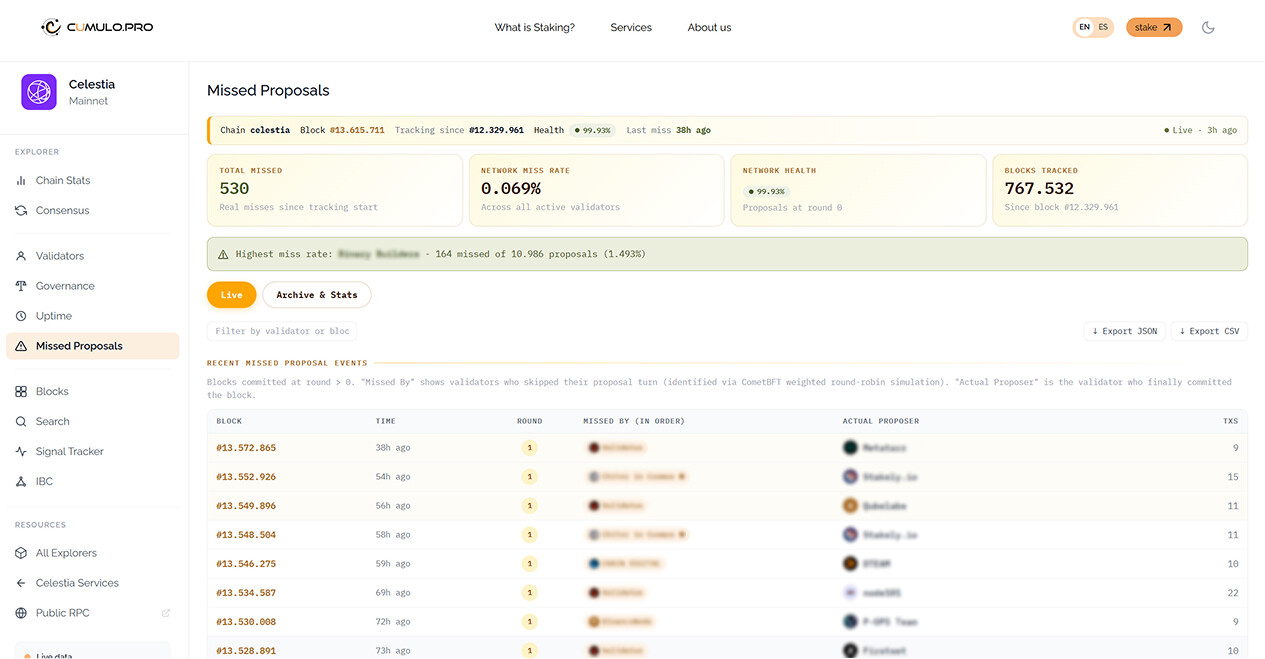
We have expanded our Celestia explorer with a dedicated Missed Proposals section, designed to provide a more accurate view of validator performance after Matcha v6.
Why uptime is no longer enough
After Matcha v6, traditional uptime stopped being sufficient on its own to evaluate validator performance.
Larger blocks and the increased pressure on P2P propagation have created a more important distinction between two concepts that were often treated together:
-
a validator’s ability to sign blocks;
-
and its ability to successfully propose a block when its proposer turn arrives.
In practice, a validator can maintain uptime close to 100%, sign every block it receives, and still miss some of its proposer turns.
That type of degradation is not reflected in traditional uptime metrics.
For this reason, we believe missed proposals have become an especially relevant metric for evaluating real validator performance on Celestia.
For more context on how validator performance metrics changed after Matcha v6, we published a more detailed analysis here:
Beyond Uptime: How Celestia Validators’ Performance Metrics Changed After Matcha v6
https://medium.com/cumulo-pro/beyond-uptime-how-celestia-validators-performance-metrics-changed-after-matcha-v6-9cbbcbdcfec1
What the tool tracks
The Missed Proposals page reconstructs and records the network’s proposal history in order to identify precisely:
-
which validators were assigned each proposer turn;
-
which proposals were successfully completed;
-
which proposer turns resulted in a missed proposal;
-
how many blocks each validator has proposed;
-
how many proposer opportunities each validator has had;
-
and each validator’s real historical proposer failure rate.
This makes it possible to clearly separate signing performance from proposer performance and detect patterns that may remain completely invisible in a conventional uptime dashboard.
The tool is available for Celestia Mainnet here:
https://cumulo.pro/services/celestia/missed-proposals
Support for mocha-5
The latest update adds support for mocha-5, Celestia’s new testnet.
This allows the same metric to be analyzed across both Mainnet and testnet, making it easier to observe validator behavior before certain changes reach production environments.
The Mocha version is available here:
https://cumulo.pro/services/celestia_mocha/missed-proposals
Automatic RPC/API fallback
One of our goals was to prevent temporary issues in our own infrastructure from creating gaps in the historical dataset.
The collector uses our own node as its primary source, but includes an automatic fallback mechanism.
If the primary RPC/API stops responding correctly, the system automatically switches to a previously verified third-party provider and continues collecting data.
Once our infrastructure becomes available again, the collector can resume using the primary source without interrupting the historical record.
The goal is to ensure that the availability of our own infrastructure does not affect the integrity of the metric we publish.
Persistent history and monthly backups
The data is not maintained only as a temporary view.
We generate permanent monthly backups of the historical dataset, available for download directly from the Missed Proposals page.
This makes it possible to preserve stable datasets for later analysis, period-to-period comparisons, or research into how validator performance evolves over time.
Data can also be exported directly from the tool in:
-
JSON, for integrations, tooling, and programmatic analysis;
-
CSV, for manual analysis, spreadsheets, or external processing.
We wanted to avoid limiting the tool to a web-based visualization and instead allow validators, developers, and researchers to reuse the data directly.

New network statistics tab
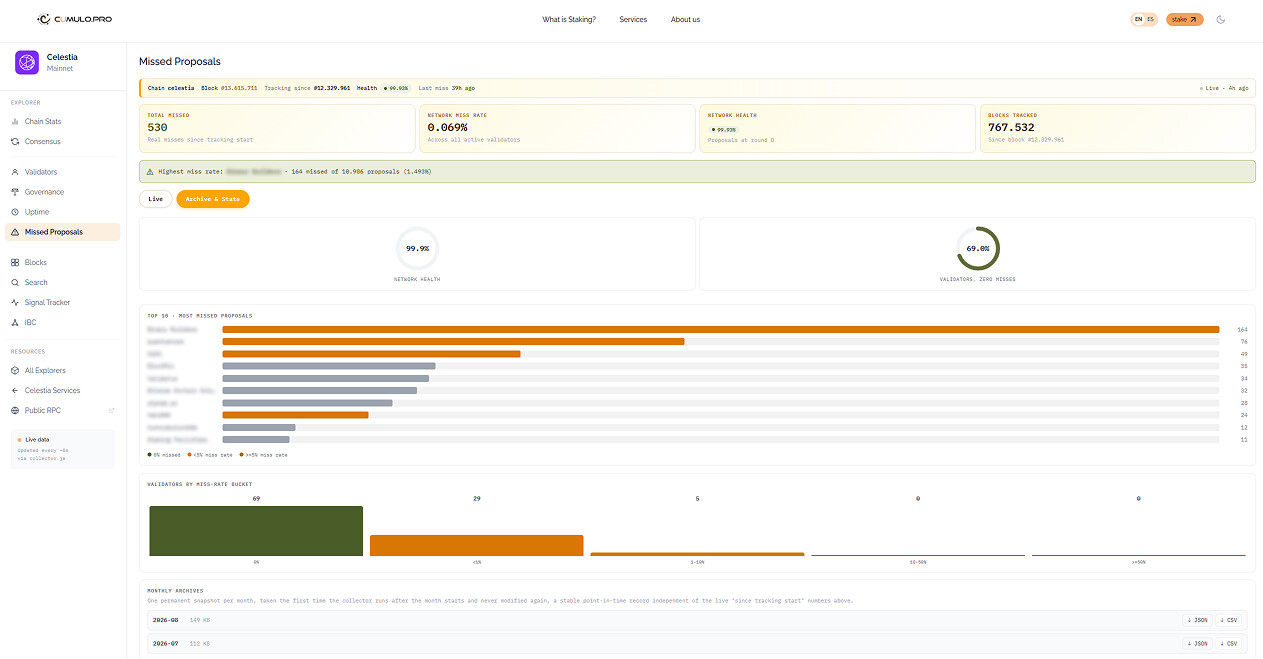
We have also added a dedicated statistics section providing an aggregated view of network-wide proposer performance.
Among other metrics, it includes:
-
validators with the highest number of missed proposals;
-
distribution of proposer failure rates;
-
comparisons of proposer performance across validators;
-
and visualizations of broader proposal patterns across the network.
This makes it possible to move from analyzing a single validator to looking at the behavior of the validator set as a whole.
Operational value for validators
For operators, missed proposals can serve as an additional signal for investigating performance issues that are not visible through signing uptime.
A high or increasing missed-proposal rate may justify reviewing areas such as:
-
P2P topology;
-
peer quality and distribution;
-
network latency;
-
bandwidth;
-
block processing time;
-
disk and I/O performance;
-
CPU contention;
-
mempool behavior;
-
consensus timing;
-
validator/sentry architecture;
-
or geographic and network characteristics affecting propagation.
A single missed proposal does not necessarily indicate a structural issue.
The real value comes from observing historical behavior and persistent patterns.
For example, if an operator changes hardware, hosting provider, region, peer configuration, or network architecture, the evolution of this metric can help determine whether the change has a measurable impact on proposer performance.
Documented and verifiable algorithm
We have also published the complete technical documentation for the algorithm used to reconstruct and identify missed proposals.
The documentation explains:
-
how proposer turns are determined;
-
how a missed proposal is identified;
-
how the historical dataset is reconstructed;
-
which data sources the collector uses;
-
and how aggregated metrics are calculated.
It also includes a step-by-step verifiable example, allowing any operator or developer to independently reproduce the calculation.
The full technical documentation is available on GitHub:
https://github.com/Cumulo-pro/cumulo-block-explorer/blob/main/docs/celestia-missed-proposals.md
Feedback
We are also using this data internally as Celestia validators to evaluate aspects of validator performance that are no longer visible through signing uptime alone.
We would be especially interested in feedback from other operators, developers, and the Celestia team regarding additional signals that could be useful around this metric.
For example:
-
correlations with peer topology or latency;
-
missed-proposal evolution across different time windows;
-
before/after comparisons following infrastructure changes;
-
additional proposer-performance metrics;
-
or datasets that could help investigate network propagation behavior.
The documentation and data are public specifically to make this type of analysis easier and to allow the results to be independently verified.