Cumulo Live Peers
When you run a Celestia node and connectivity starts failing, a static peer list is often not enough.
What you need in that moment is simple: peers that are actually reachable from the outside right now, not peers that were visible from one node a few days ago.
That is why we built Cumulo Live Peers.
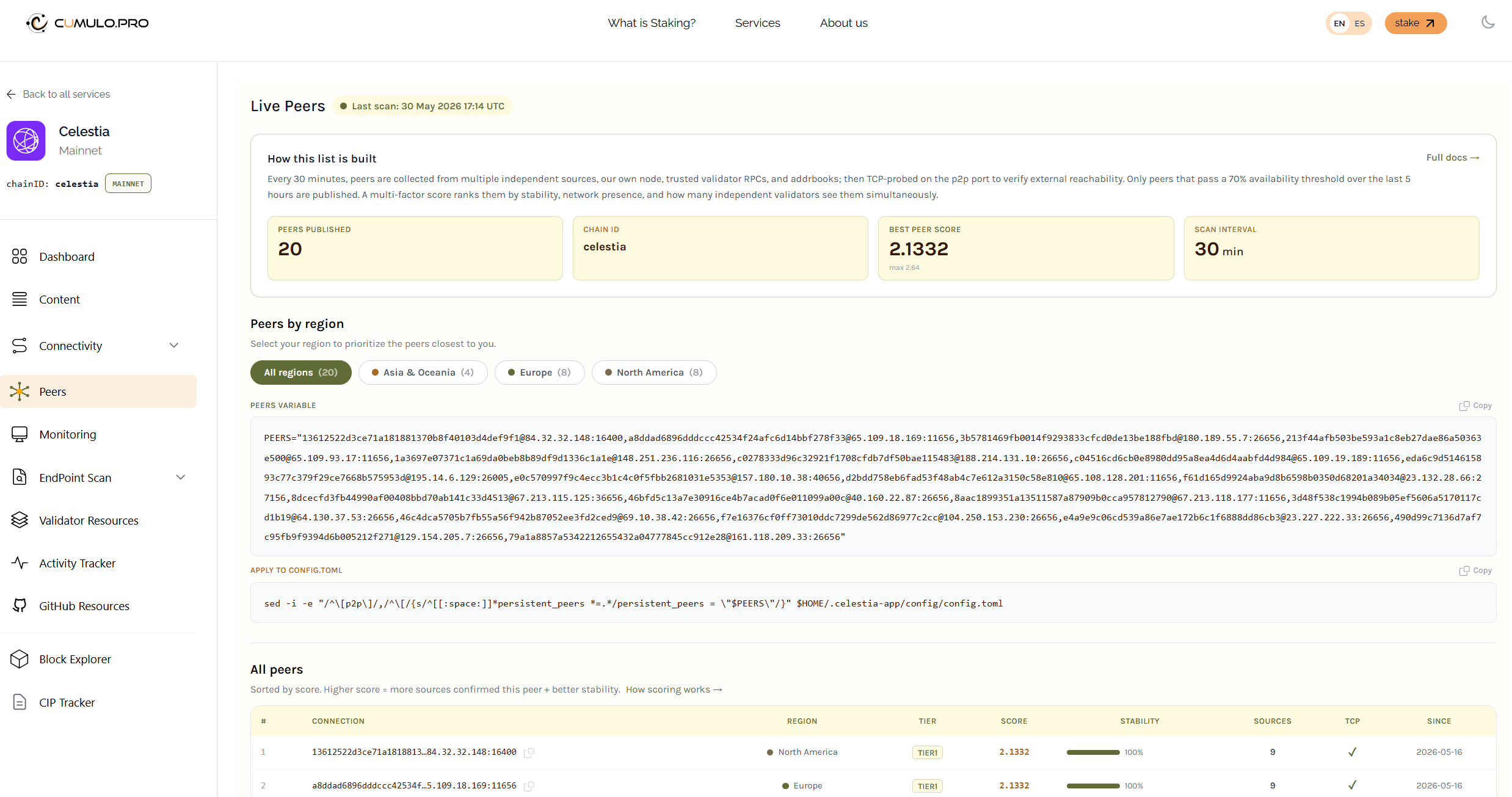
It is a live peer checker for Celestia mainnet and Mocha testnet, updated every 30 minutes and available through both a public dashboard and API.
The idea is straightforward: keep checking which peers are really reachable, filter out the unstable ones, and give node operators a list they can actually use.
How it works
Every cycle, Cumulo Live Peers builds a candidate pool from several sources:
-
Our own Celestia nodes
-
RPC endpoints from validators in the ecosystem
-
Addrbooks and peer lists collected from validator resources
-
Peers contributed directly by operators
Then we test each candidate with a direct TCP check against its P2P port.
If a peer is not reachable from the outside, it does not make it into the published list.
We also do not publish peers just because they appeared once. To be included, a peer needs to show consistent stability across roughly the last 5 hours of observations. If a peer disappears or becomes unreachable, it is automatically removed after a few cycles.
Not just “more peers”
The goal is not to publish the biggest possible list.
The goal is to publish a useful one.
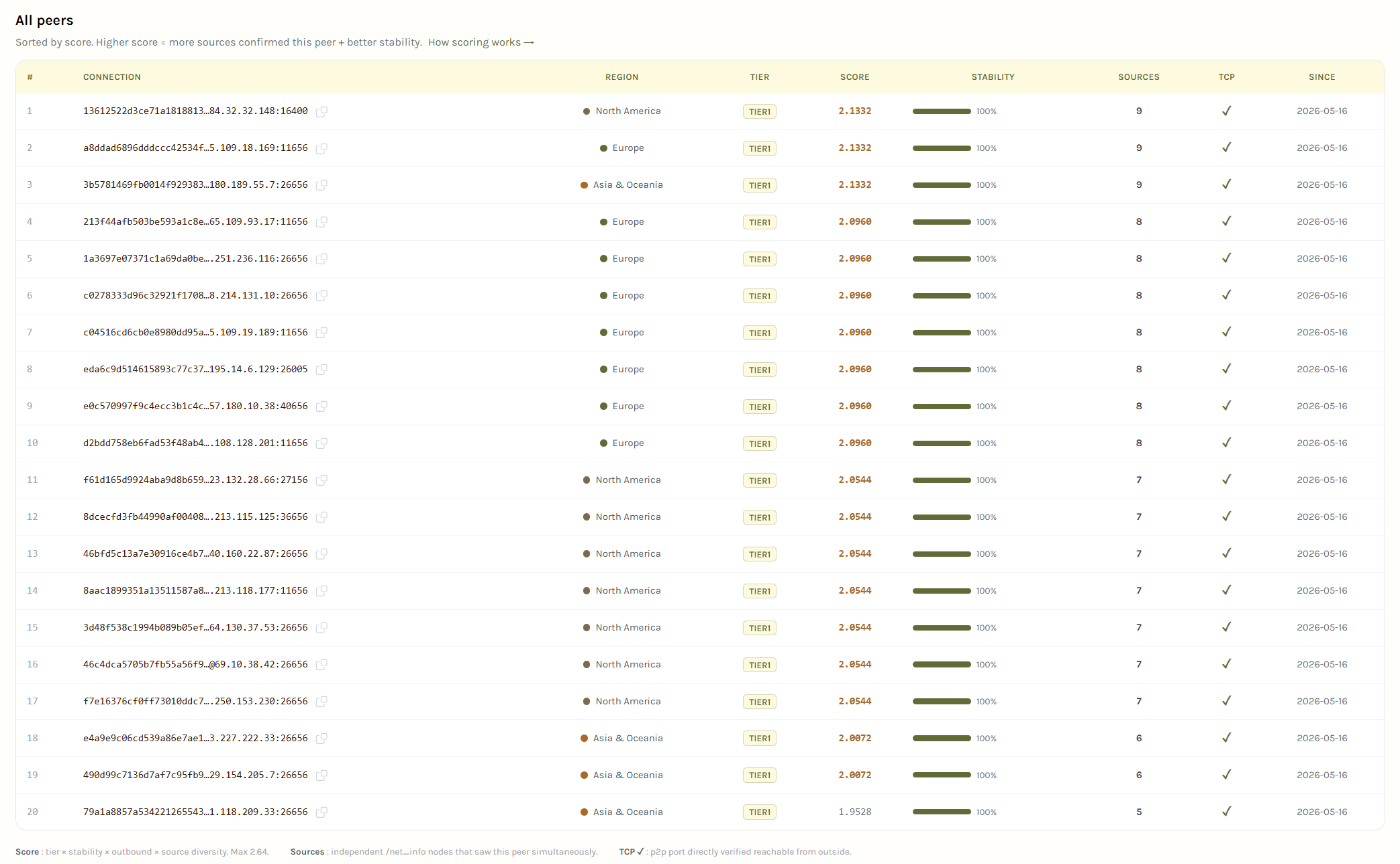
Peers are scored based on:
-
Recent stability
-
Outbound activity
-
How many independent sources confirmed the same peer
-
Geographic diversity
This helps avoid lists full of random peers that may not help much in practice, especially when an operator is trying to recover connectivity quickly.
Ready to use
You can use the live peer lists here:
Mainnet:
https://cumulo.pro/services/celestia/peers
Mocha testnet:
https://cumulo.pro/services/celestia_mocha/peers
Full technical documentation:
https://github.com/Cumulo-pro/Cumulo-Front-Chain/blob/main/check_peers/PEERS_SYSTEM.md
The result is an always-updated list of the most stable and well-connected peers in the network, ready to apply with a single command.
Why we built this
At Cumulo, we run validator infrastructure across Celestia and other modular networks, and peer connectivity is one of those operational problems that looks simple until it is not.
Most operators have had that moment where a node is stuck, peers are not behaving as expected, and the usual static lists are not helping much.
Cumulo Live Peers is our attempt to make that part of node operations a little more practical: live checks, public data, reproducible logic and a list that keeps updating without anyone having to maintain it manually.
Validator resource lists
To make the external sources more useful, we also maintain public validator resource lists for Celestia mainnet and Mocha testnet.
These include RPCs, addrbooks and contributed peers.
The more validators contribute their resources, the better the scoring becomes for everyone, because the system can compare more independent sources and build a more representative view of the network.
If you are a Celestia validator and want to add your resources, you can open a PR here:
Mainnet validators:
https://github.com/Cumulo-pro/Cumulo-Front-Chain/blob/main/Celestia/data/validators.json
Testnet validators:
https://github.com/Cumulo-pro/Cumulo-Front-Chain/blob/main/Celestia/data/validators_testnet.json
We hope this is useful for Celestia validators, node operators and teams running infrastructure.
Feedback, suggestions and validator contributions are very welcome.