I’d agree with placing shared security sharded blockchains under proto-modular, particularly because at a high level they are similar in design to Ethereum + rollups. To redefine proto modular under this premise it would refer to any monolithic blockchain that outsources at least one component of the stack to another modular blockchain, or in the case that it is sharded with shared security provided by a common shard that relieves all other shards of at least one component.
To also redefine pseudo modular, it would refer to monolithic blockchains that split the single network into multiple parts where there is no sense of shared security, and each individual part is itself monolithic.
For Mina, once the bridge is live and functioning then I would consider it to be proto modular because it would then have the ability to utilize another proto modular blockchain (Ethereum) for consensus.
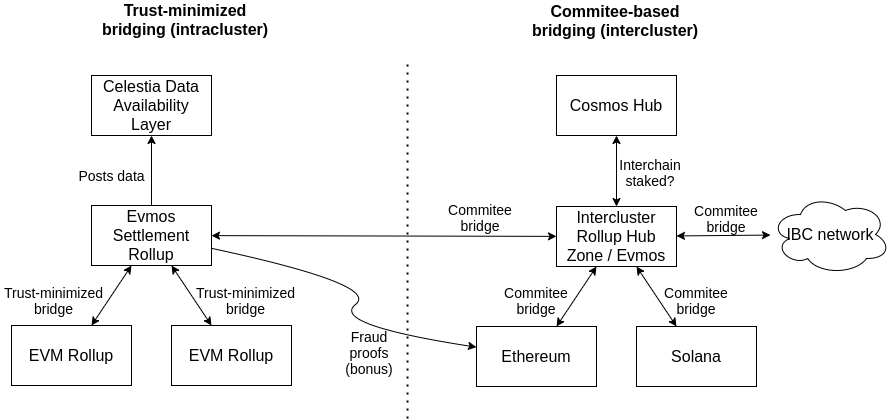
As for the modular endgame, the design is similar to the initial conception of Celestia and Evmos – as demonstrated by Mustafa here. The idea is that Evmos would provide an EVM-based settlement layer for rollups on Celestia. The flow would start with a transaction on the rollup providing execution. It would then be batched and sent to the rollup providing settlement and, in the case for a zkRollup a validity proof would also be verified. Finally, the settlement rollup would batch transaction data and send it to Celestia for DA guarantees and consensus over ordering. There’s the recursive rollup-on-rollup design.