Fibre from the validator side (v10 lab)
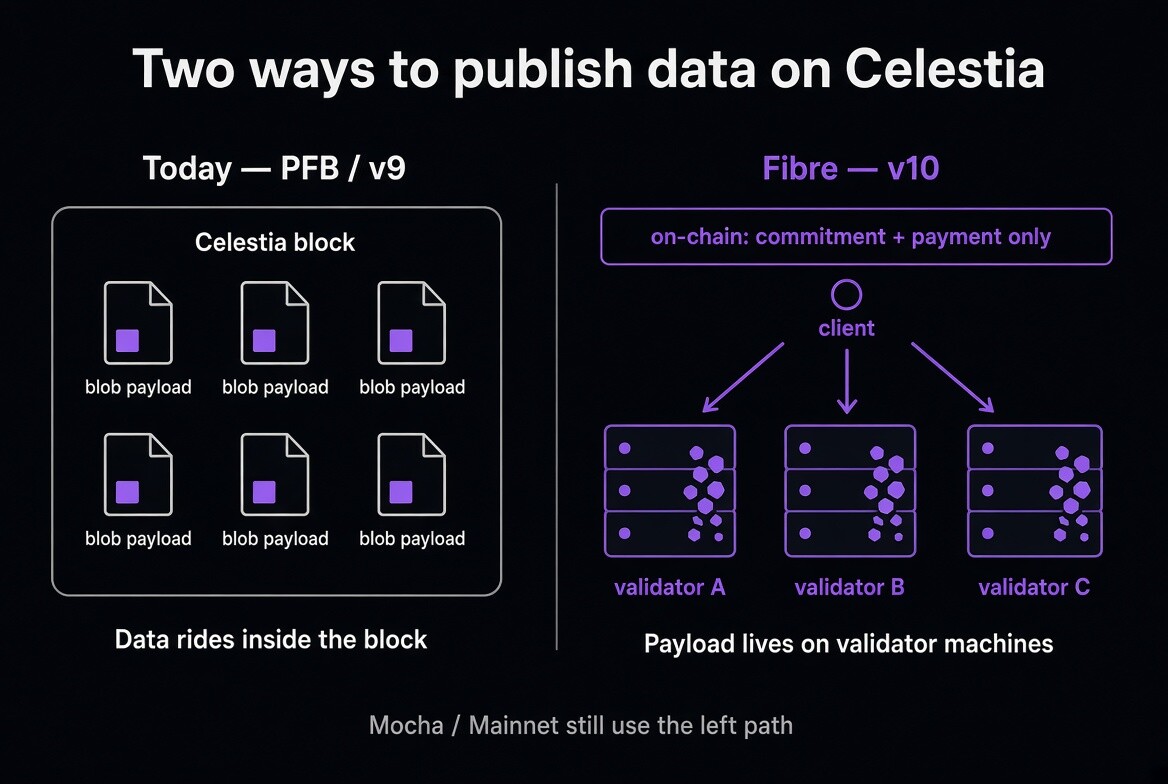
Network status
Mocha and Mainnet are app v9.
x/valaddr/x/fibreare not in state.
celestia-appd tx valaddr set-hostrejects until app version 10.Operator note: Encoding is in CIP-51 /
fibre/cmd/README.md. Reply with file + line if this is wrong.
Operator
- Moniker:
- valoper:
- Region / DC:
- Hosting: [provider]; if FDP: not Hetzner / OVH
- Lab: [celestia-appd version] / [fibre version]
What has to run
| Process | Role | Default |
|---|---|---|
celestia-appd |
consensus + settlement app | gRPC 127.0.0.1:9090 |
fibre |
shards, prune, client TLS | 0.0.0.0:7980 |
privval |
gRPC endorse TLS + sign promises | 127.0.0.1:26669 |
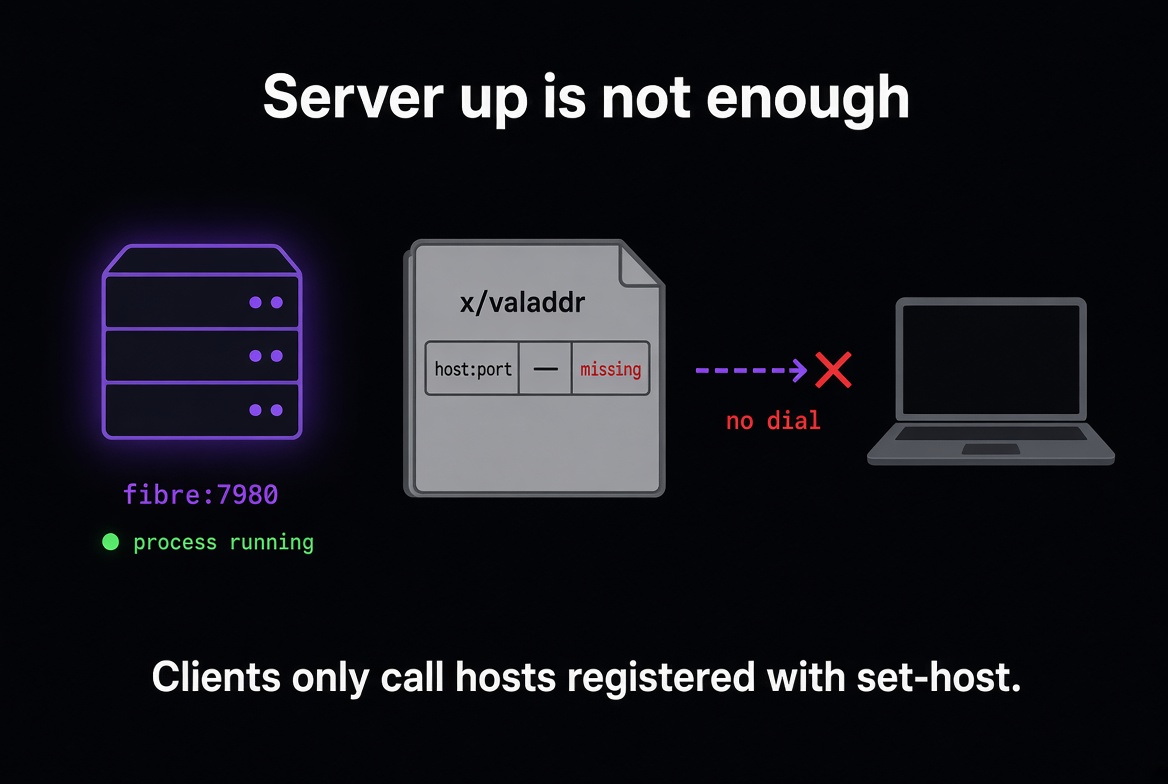
Clients dial only x/valaddr. No set-host = no traffic.
set-hostbefore v10 fails.--app-grpc-addressand--signer-grpc-addressare plaintext. Loopback or closed link only. Do not publish9090/26669.- Unbonded / not in the active validator set: storage budget
0. Process can be up and still receive nothing.
Client ↔ Fibre is TLS 1.3.
An Ed25519 TLS keypair is created on every Fibre start. The self-signed cert is endorsed by the consensus key and reminted on restart.
Registry accepts IP or DNS because identity is the consensus key.
--home is the store. Under it:
shards/staging/- Pebble metadata
Do not delete or recreate this directory on restart or binary upgrade.
Prune
Every minute:
pruneAt = max(ExpiresAt, created + ShardRetention)
Default ShardRetention = 4h unless params change.
CIP-51 defines fibre.FullStakeStorageBudget = 2 TiB by default; CIP-52 draft lists that default at v10 initialization.
A given validator’s budget is stake-derived and governance-changeable.
Headroom on disk is still needed for staging + Pebble.
Do not treat 2 TiB as a machine spec.
Remote signer must implement SignRawBytes.
Docs target:
median cometbft_privval_signing_latency_* ≤ 10ms
Lab — v10 local only
Do not point these at Mocha.
After make build-fibre-server, use ./build/fibre so $PATH cannot pick an older install.
If the release binary is already at /usr/local/bin/fibre, that path is fine.
make build-fibre-server

./build/fibre version

./build/fibre start \
  --home /var/lib/celestia-fibre \
  --app-grpc-address 127.0.0.1:9090 \
  --server-listen-address 0.0.0.0:7980 \
  --signer-grpc-address 127.0.0.1:26669
Helpers:
scripts/single-node-fibre.sh
scripts/submit-fibre-blobs.sh
tools/fibre-txsim
Register the Fibre host
celestia-appd comet show-address

celestia-appd tx valaddr set-host 127.0.0.1:7980 \
  --from <operator-key> \
  --chain-id <local>

celestia-appd query valaddr provider <celestiavalcons...>
Host format:
host:port
Requirements:
- port
1–65535 - max 100 chars
- no scheme
- no path
Pass
- query returns the host
- submit exits
0 - reconstruct matches
Fail
Typical causes:
- still v9
- privval gRPC off
- bind
127.0.0.1while the client is elsewhere - skipped
set-host - signer changed and Fibre not restarted
Please include these when reporting a lab result:
[celestia-appd version]
[./build/fibre version]
[query valaddr provider]
[local set-host tx hash]
systemd
Create and chown the home first, or use StateDirectory.
With StateDirectory, systemd owns:
/var/lib/celestia-fibre
Example unit:
[Unit]
Description=Celestia Fibre server
Wants=network-online.target
After=network-online.target celestia-appd.service
Requires=celestia-appd.service

[Service]
User=celestia
StateDirectory=celestia-fibre
ExecStart=/usr/local/bin/fibre start \
  --home /var/lib/celestia-fibre \
  --app-grpc-address 127.0.0.1:9090 \
  --server-listen-address 0.0.0.0:7980 \
  --signer-grpc-address 127.0.0.1:26669
Restart=always
RestartSec=3
LimitNOFILE=65535

[Install]
WantedBy=multi-user.target
Prepare 7980/tcp on the firewall.
Do not
systemctl start fibreagainst Mocha/Mainnet while they are v9.
Keep /var/lib/celestia-fibre across upgrades.
Order on a v10 chain
appd healthy
    ↓
app / privval gRPC reachable
    ↓
start Fibre process + listen
    ↓
set-host
Registering a dead host makes clients time out.
Day the network is v10
Before height
Have the following ready:
- backup
- matching
appd+ Fibre - privval gRPC configured
- persistent Fibre home
- systemd unit installed
- firewall prepared for
7980 - public
host:port
Do not start Fibre against the v9 network.
After height
Expected order:
app v10 and bonded
    ↓
gRPC healthy
    ↓
Fibre listening
    ↓
set-host
    ↓
query valaddr provider
    ↓
record UTC + tx hash
GC
The record is dropped if the validator:
- leaves staking, or
- is jailed and unbonded for more than 7 days
Run set-host again only after you are back and the record is gone.
Ops target
We will run Fibre + set-host within 24h of Mocha v10 on:
[host / region]
That is our ops target, not an extra FDP clause.
FDP text is:
- run Fibre once it is live
- upgrade in 24h
- no Hetzner/OVH
Five checks
| # | Check | Mocha/Mainnet today | Local v10 lab |
|---|---|---|---|
| 1 | Fibre process | install / version-check only; do not start | yes |
| 2 | :7980 listen |
n/a until network v10 | yes |
| 3 | valaddr host |
n/a — no module | yes |
| 4 | shard I/O | n/a | yes, generate it |
| 5 | filesystem of --home < 80% |
operator alert, not a CIP rule | same |
Public label until network v10:
Fibre: waiting.
Watch:
- journal
- prune
- store
- sign
There is no first-class Fibre gauge for disk %.
Use node exporter for filesystem monitoring.
Breakage / troubleshooting
| Seen | Do |
|---|---|
0 traffic, process up |
check registry, firewall, bind 0.0.0.0, bonded status |
set-host rejected |
still v9 / bad host:port / wrong key |
| query empty | wait for commit; run comet show-address |
| creating signer | check privval gRPC |
storage budget is 0 |
validator not bonded / not in active set |
| TLS errors after key change | restart Fibre to generate a new cert |
| disk full | check prune loop; do not wipe $FIBRE_HOME |
| jailed | unjail; query registry; run set-host only if GC’d |
Server config exposes:
MaxMessageSizeUploadVerifyWorkers
There is no per-peer rate limiter in the server spec.
A normal TLS-terminating proxy will break Fibre validator-identity verification.
Use TCP/L4 passthrough unless the intermediary implements Fibre-endorsed TLS identity.
Do not
- Call the lab Mocha or Mainnet.
- Run
set-hoston v9. - Start Fibre against Mocha/Mainnet while they are v9.
- Publish
9090/26669. - Wipe
$FIBRE_HOMEto “fix” a restart. - Put the FDP Fibre host on Hetzner/OVH.
- Publish
1 Tb/sor2 TiBas your SLO.
Questions
-
If Fibre is not on the
appdbox, how are you fencing plaintext9090and26669? -
Which remote KMS actually does
SignRawBytes, and does signing stay≤ 10msacross restart / cert remint? -
How are you watching store occupancy + prune health? Metrics cover prune/store latency, not filesystem
%. -
Is
7980raw to the internet, or L4 passthrough / limiter? -
Lab
set-host: IP or DNS, and what is the procedure when the box moves so the registry is not stuck on a dead endpoint?