
About VALIDEXIS
VALIDEXIS is a globally distributed infrastructure team contributing to the decentralization and observability of the Celestia network. We design and operate high-performance validator and bridge nodes, develop open analytics tools, and build AI-powered monitoring systems that make Celestia’s modular architecture transparent and reliable. Our mission is to combine secure infrastructure, data-driven insights, and open-source tooling to strengthen the resilience of the Celestia ecosystem.
Track Record & Recognition

Recognized across multiple ecosystems for reliability, transparency, and open-source contribution:
 Celestia Foundation (R&D Delegation 2025) — awarded for AI analytics and observability tools.
Web3 Foundation (Polkadot & Kusama DN) — delegation for validator reliability and ecosystem support.
StarkWare Delegation Program — recognition for uptime and secure validator operations.
Active validators in 10+ ecosystems, including Celestia, Polkadot, Kusama, Starknet, Cosmos, Solana, and others.
Our Team
A decentralized group of professionals with expertise in infrastructure, DevOps, monitoring, and validator operations.
Our core specializations include:
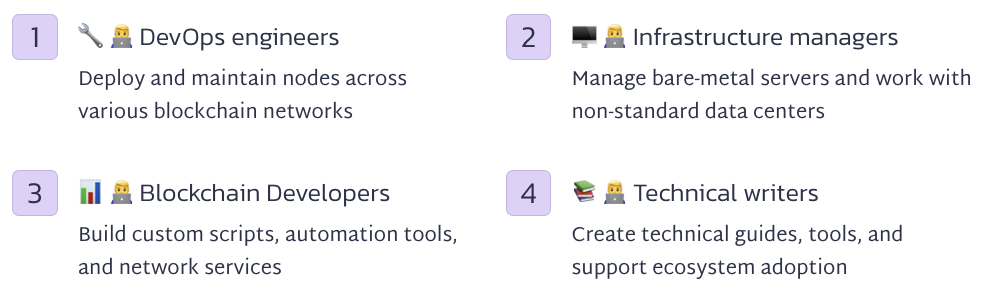
We are distributed across multiple regions, including:
🇩🇪 Germany — 🇿🇦 South Africa — 🇦🇪 UAE — 🇹🇭 Thailand — 🇰🇿 Kazakhstan
Infrastructure
VALIDEXIS operates a fully self-managed bare-metal infrastructure hosted in Tier-3 carrier-neutral data centers in Cape Town, South Africa. This location provides a unique balance of low-latency regional routing, physical security, and strategic decentralization — helping strengthen Celestia’s network presence in one of the most underrepresented regions globally

Each deployment is optimized for performance, redundancy, and resilience, supporting Celestia’s mission to decentralize node infrastructure beyond traditional regions and centralized cloud providers.
Validator & Bridge Node Specifications
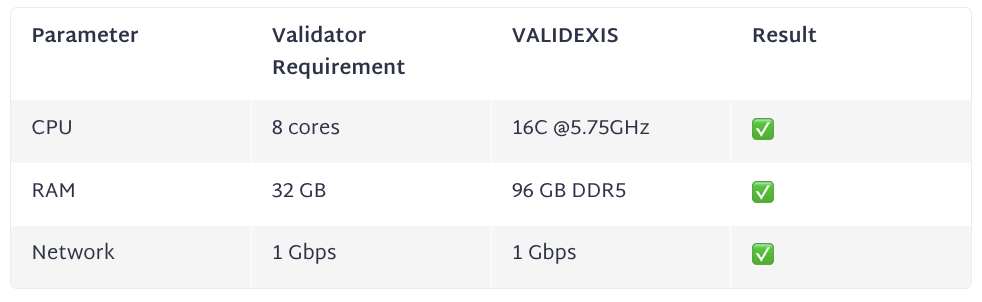
Our infrastructure in Cape Town, South Africa is powered by high-performance bare-metal servers that significantly exceed the recommended Celestia hardware requirements. Each node is optimized for reliability, redundancy, and network throughput to ensure stable block production and data availability performance.
Validator Hardware
• Location: Cape Town, South Africa
• Type: Tier-3 carrier-neutral data center (bare metal)
• Hardware: AMD Ryzen 9 9950X — 16 C / 32 T (4.5 GHz base / 5.7 GHz boost), 96 GB DDR5, 4TB NVMe SSD, 1 Gbps unmetered bandwidth
Bridge Node Hardware
• Location: Cape Town, South Africa
• Type: Tier-3 carrier-neutral data center (bare metal)
• Hardware: AMD Ryzen 9 9900X — 12 C / 24 T (4.4 GHz base / 5.6 GHz boost), 128 GB DDR5, 12TB NVMe SSD, 1 Gbps unmetered bandwidth
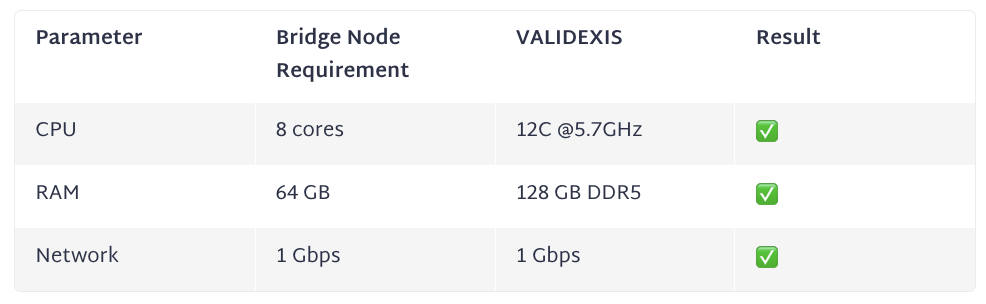
Each node undergoes regular performance and I/O benchmarking to ensure optimal operation under mainnet and bridge workloads.
Full benchmark data (CPU, RAM, Storage, Network, and fio tests) are available upon request.
Monitoring and Security
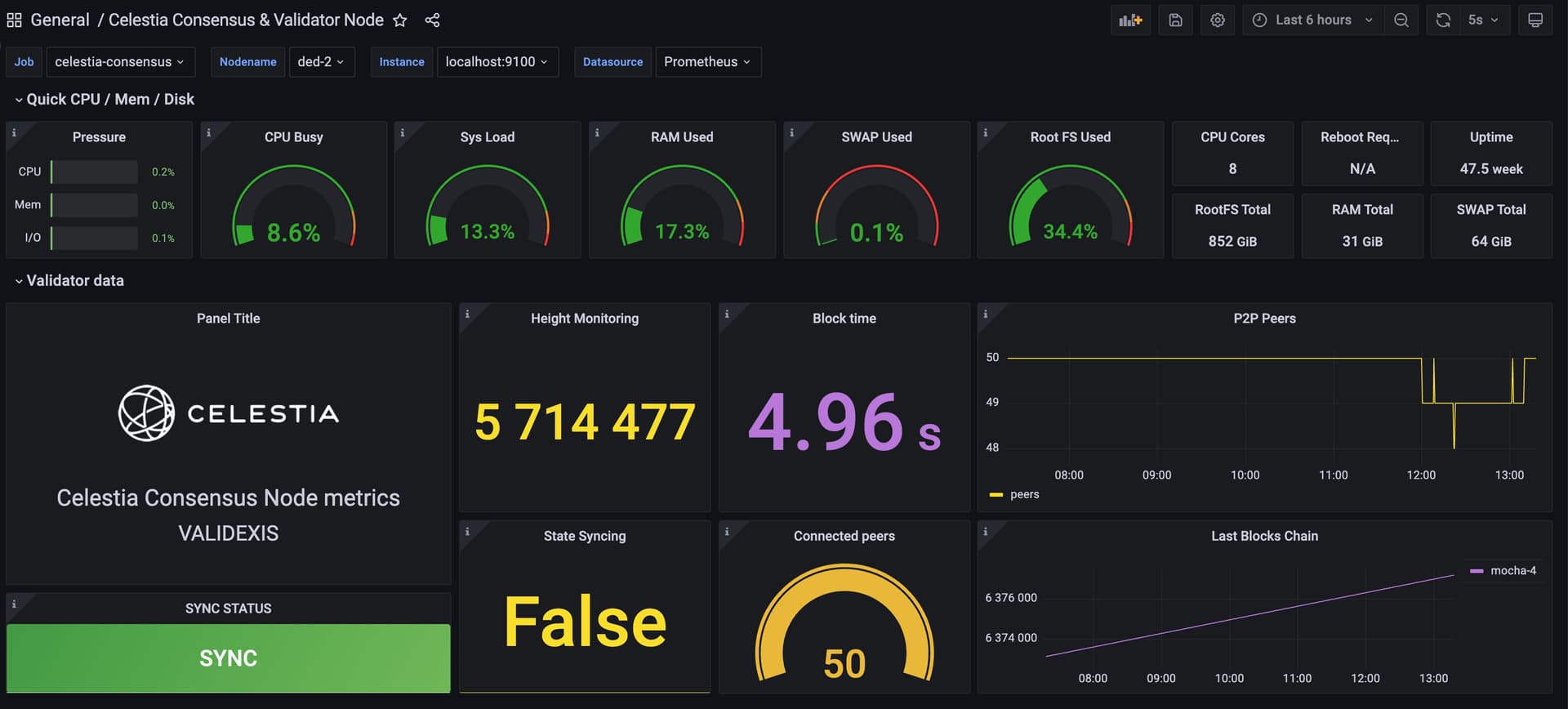
 Stack
Stack
We use a modern and fully integrated observability stack:
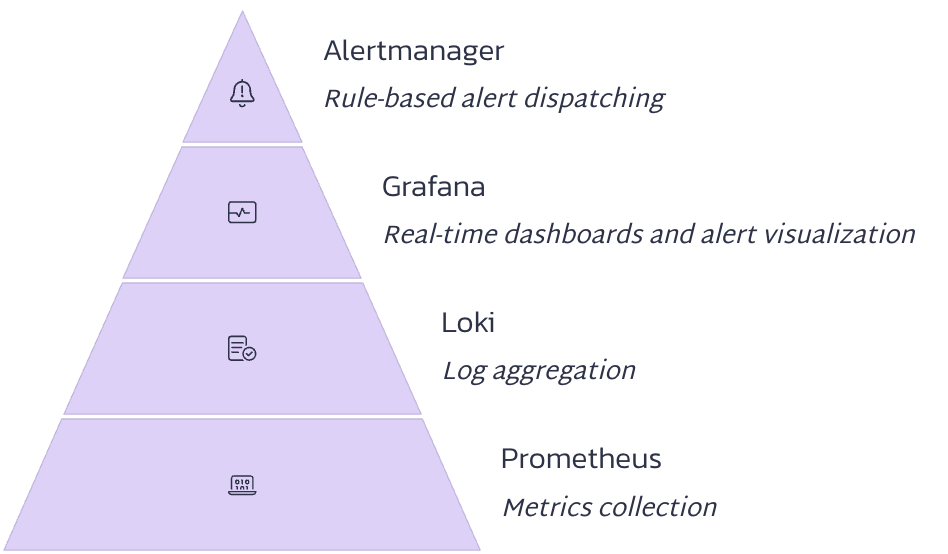
Our infrastructure is monitored 24/7, with automatic alerts sent to Telegram and Discrod. Dashboards are fully customized for node health, sync status, resource usage, and staking behavior.
 Security
Security is our top priority — both on the infrastructure and access level. VALIDEXIS follows a multi-layer security architecture designed to protect validator integrity, prevent double-signing, and ensure operational safety across all Celestia components.
Our approach combines hardware-based isolation, segmented network design, and continuous observability to maintain maximum reliability and fault tolerance.
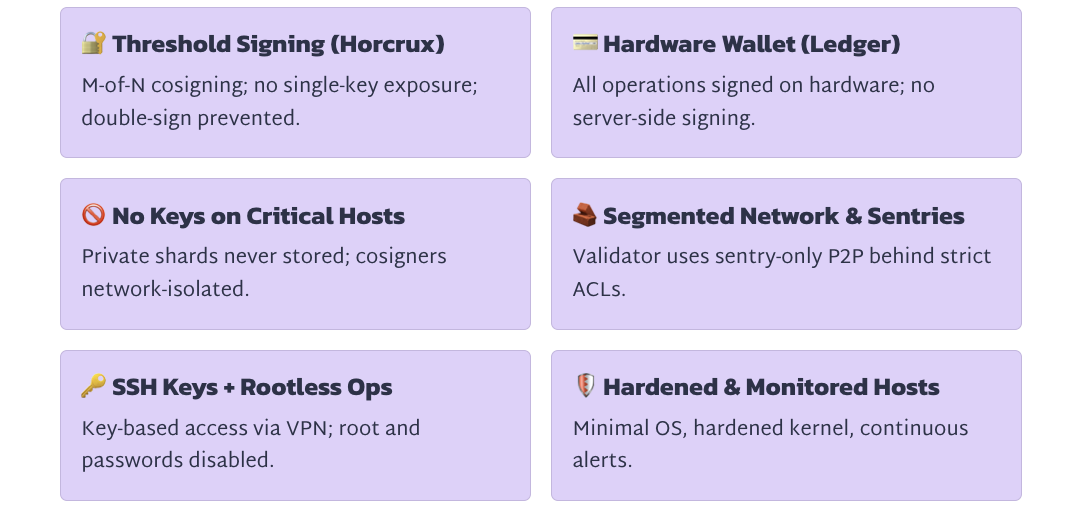
To further secure key management, our signing process uses Horcrux, a distributed M-of-N threshold system where the validator key is never stored or reconstructed on any single node.
 Horcrux
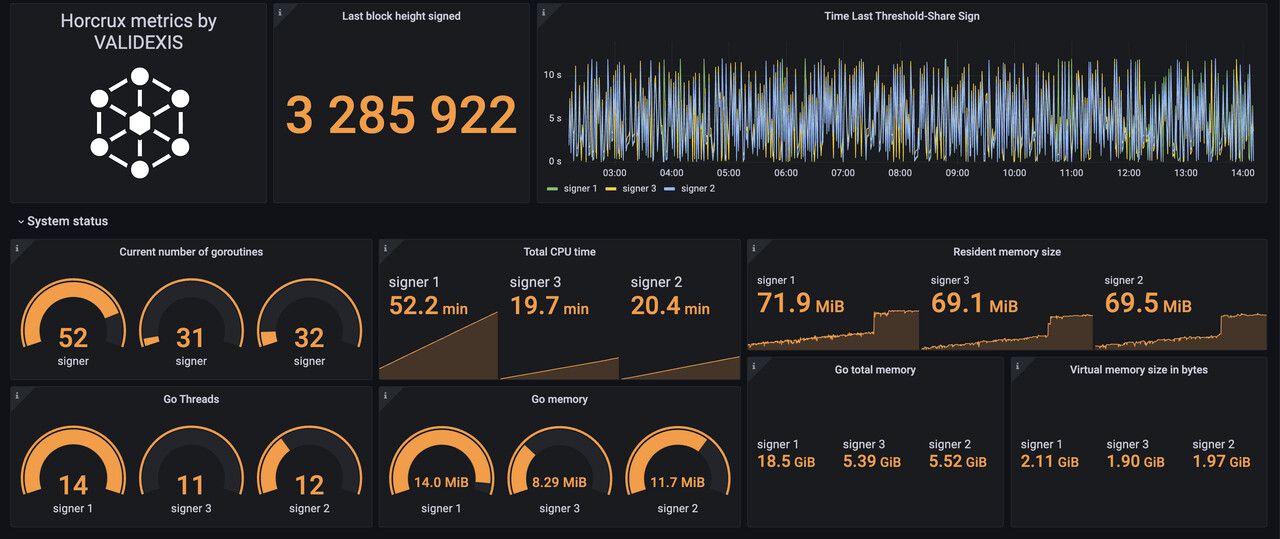
We use Horcrux, a distributed key-signing system with a 2-of-3 threshold scheme, to securely operate our Celestia validator.
The validator private key is never stored or reconstructed on a single machine, significantly mitigating key-compromise and double-sign risks.
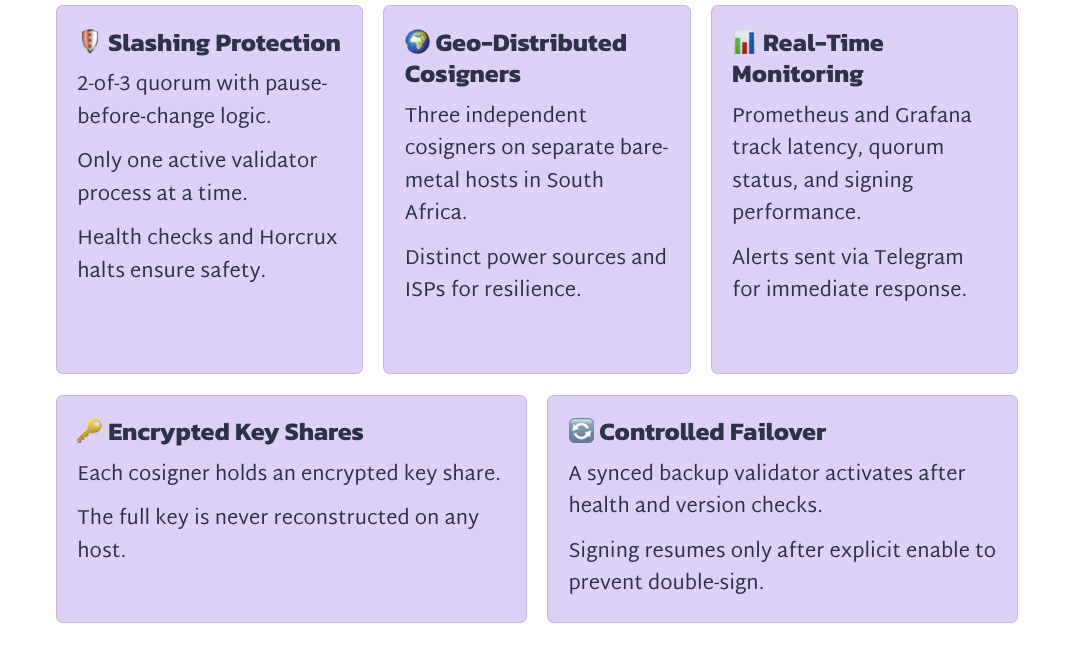
Additional safeguards include NTP drift alerts, version gating, and offline recovery procedures ensuring safe continuity without key exposure.
Contributing to the Ecosystem
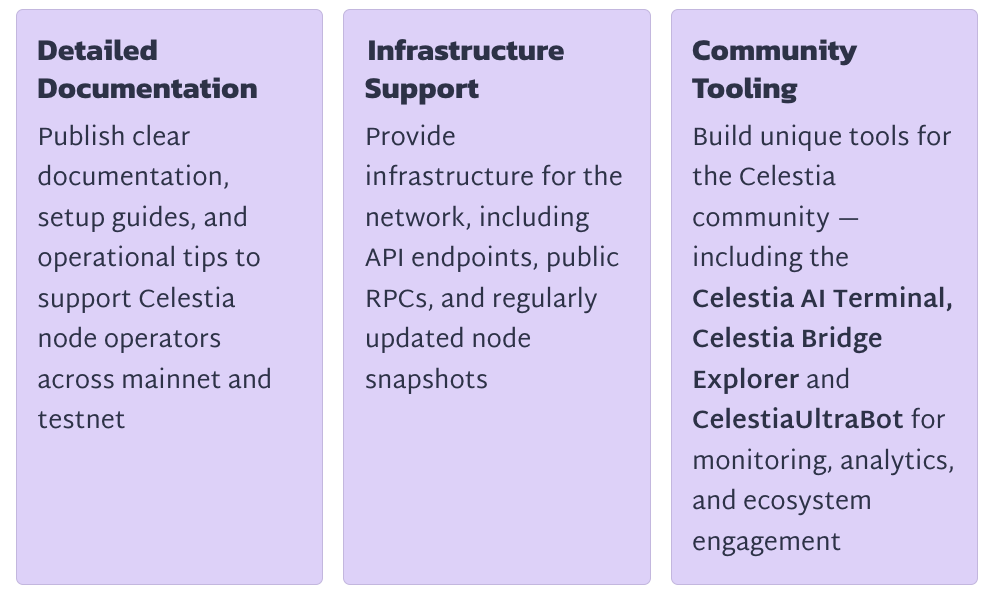
As long-term infrastructure operators, we contribute to the Celestia ecosystem not only by running reliable validators, but also by building tools, writing documentation, and supporting the broader community.
Celestia Bridge Explorer
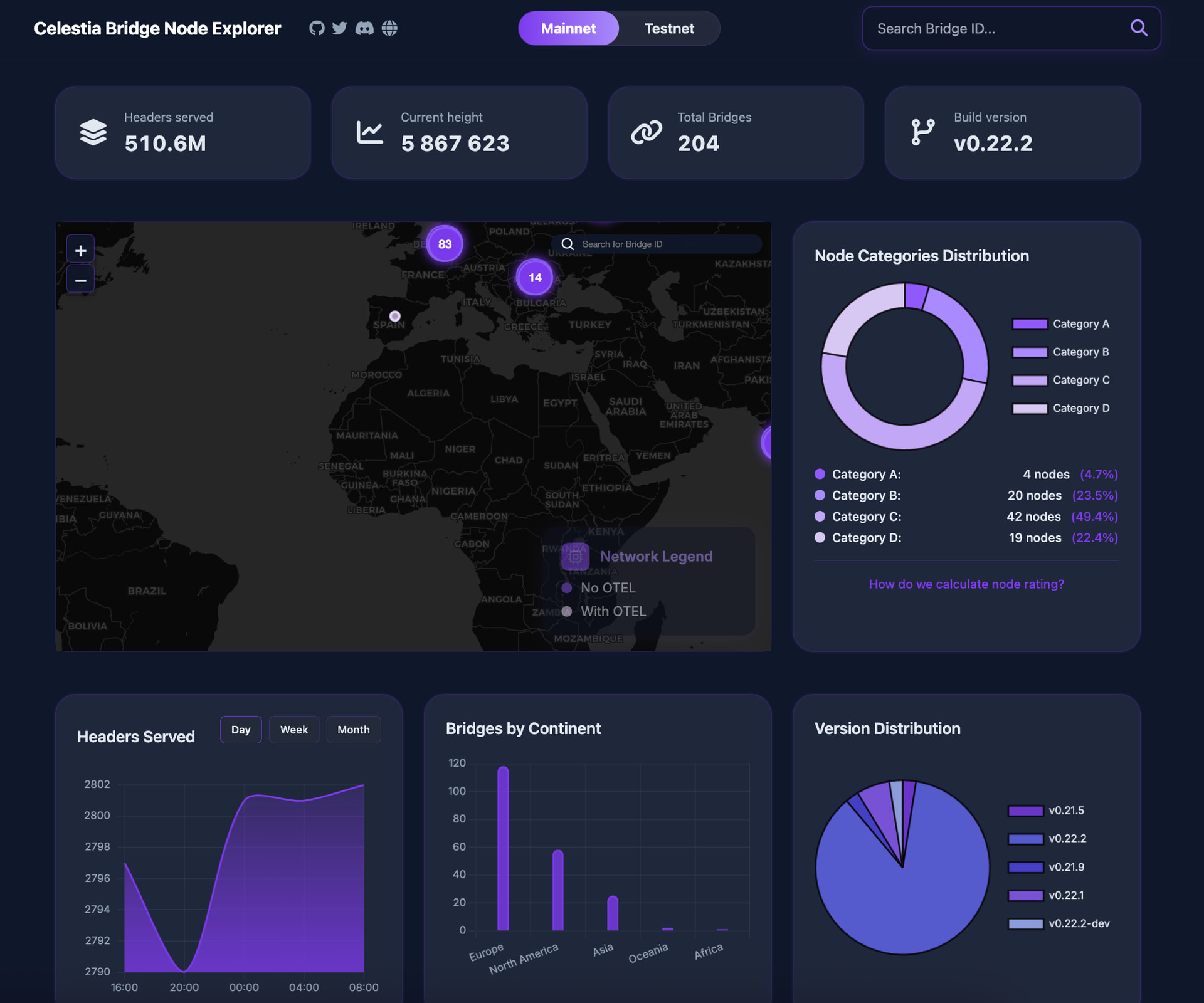
Celestia Bridge Explorer is a web-based dashboard that visualizes the performance, uptime, sync status, geographic distribution, and upgrade adoption of Celestia bridge nodes using open OTEL metrics. Built for both the community and the Celestia core team, it enables real-time monitoring of bridge reliability, upgrade responsiveness, and overall network health in a single, accessible interface.
 Upgrades
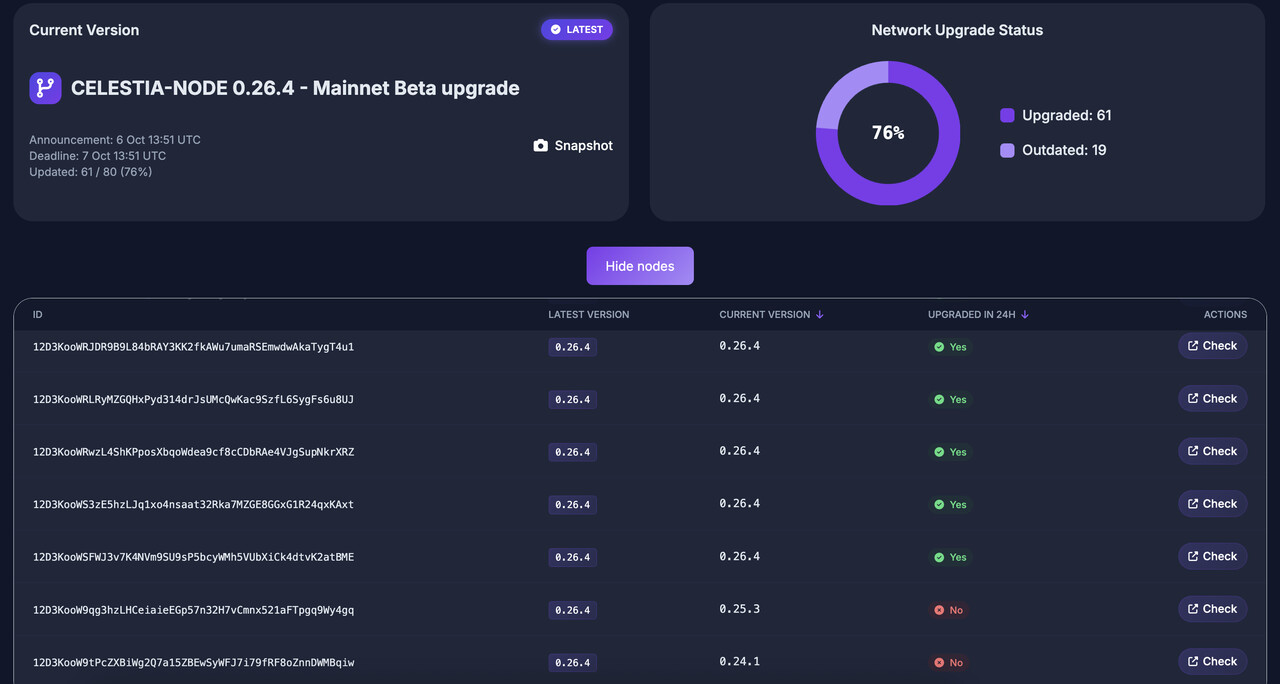
Monitors how quickly bridge nodes adopt new Celestia releases. Shows version status and measures upgrade responsiveness within 24 hours — a key reliability metric for Foundation Delegation participants. Each version is paired with an OTEL snapshot taken exactly 24 hours after release, ensuring consistent and transparent upgrade analysis.
Node Details
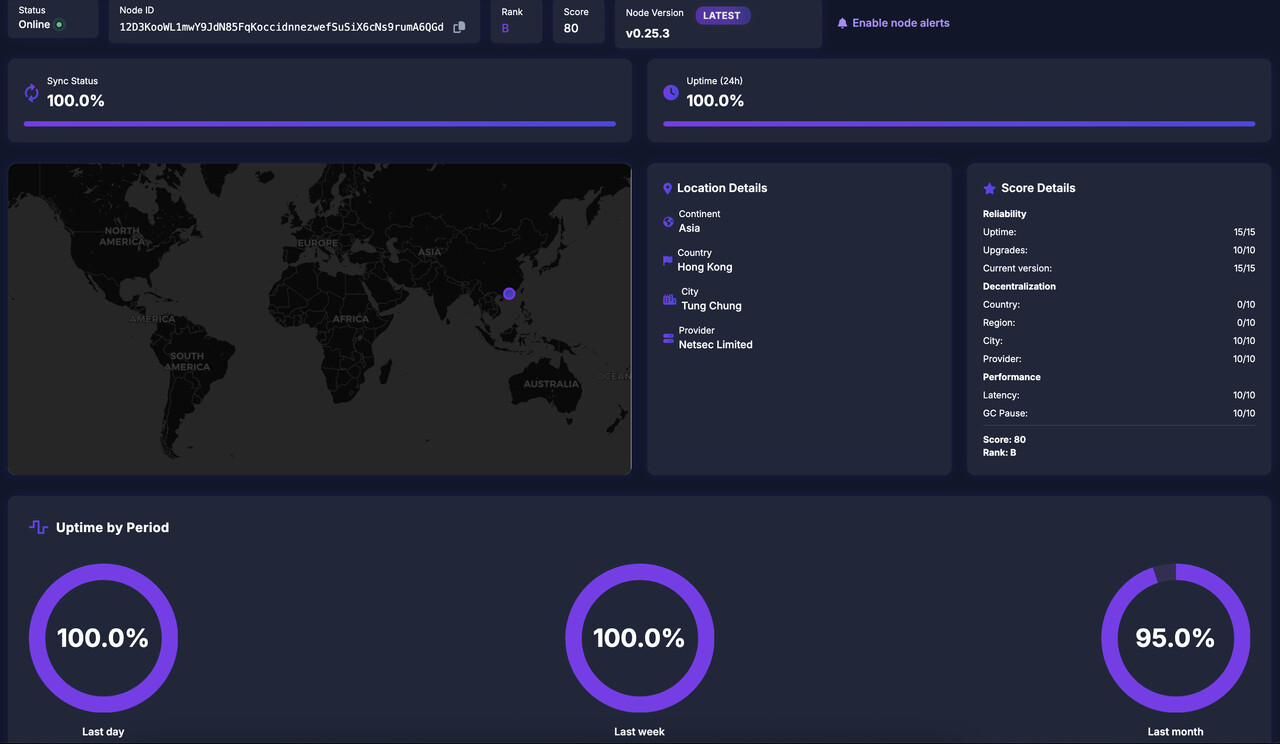
Displays a complete technical profile for each Celestia bridge node — including sync status, uptime, version, location, and hosting provider. Each node is evaluated across reliability, decentralization, and performance to highlight trusted operators. Real-time metrics such as latency, GC pause, and activity charts reflect node stability and efficiency. Upgrade history with 24h adoption flags and linked OTEL snapshots provides clear, time-based performance insights.
 Analytics
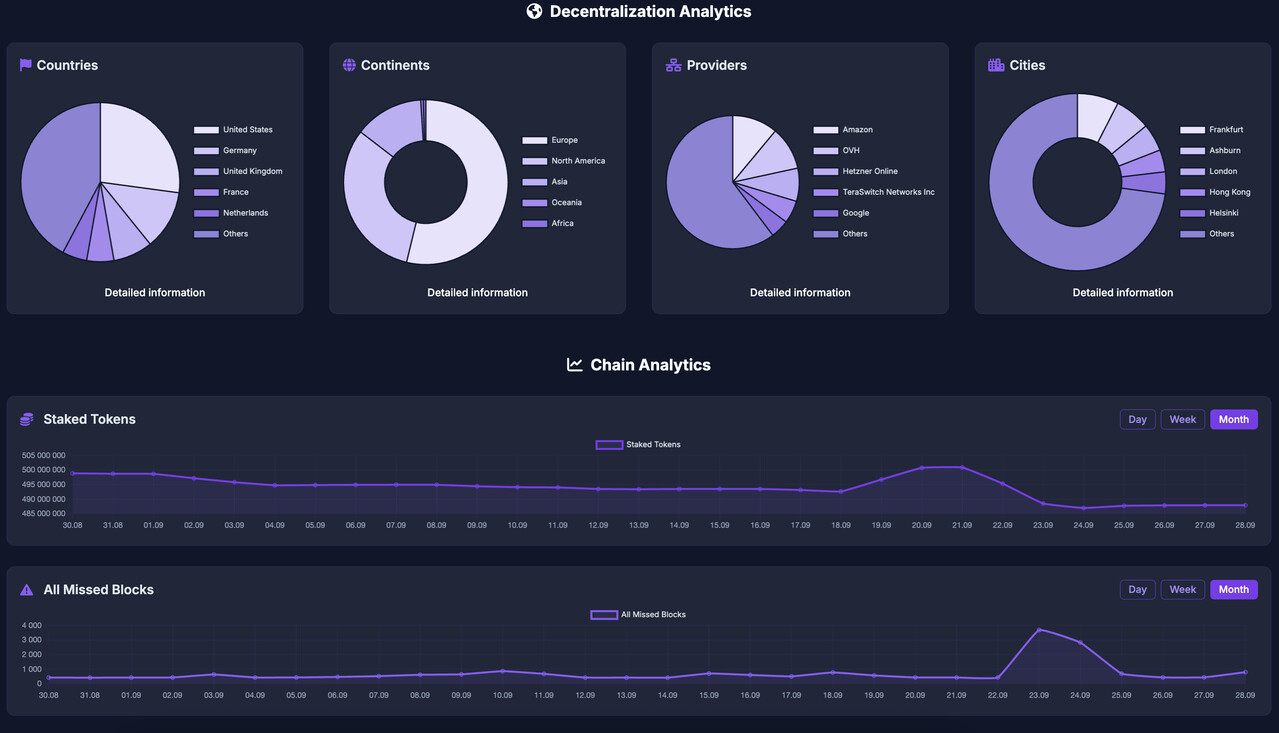
Provides a global view of network decentralization and bridge health. Breaks down node distribution by country, region, provider, and city to highlight centralization trends. Tracks key metrics like staked tokens, missed blocks, average latency, GC pause, and memory usage — essential for detecting anomalies and ensuring long-term network resilience.
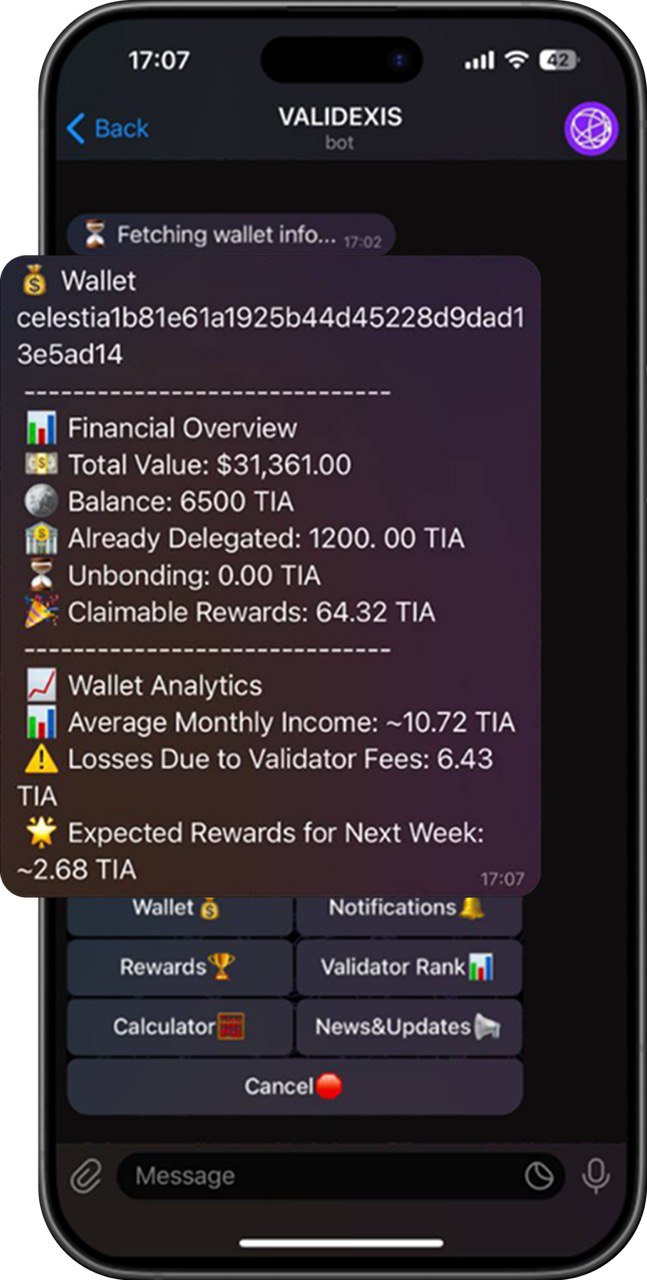
Through seamless integration with our Telegram bot, users can set up real-time alerts for validator activity, bridge node performance, wallet transactions, and staking events — making critical insights instantly accessible.
CelestiaAI
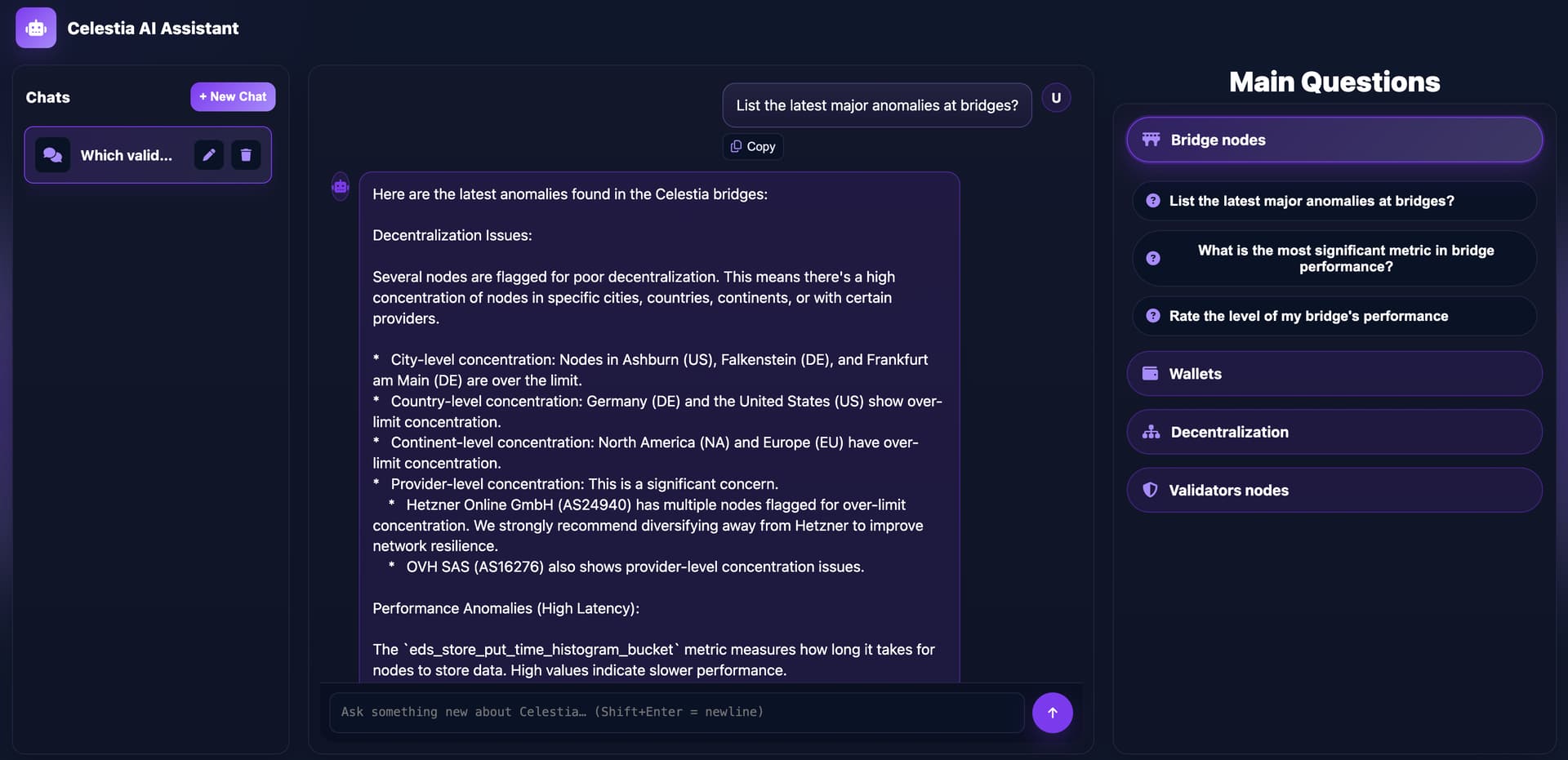
CelestiaAI Terminal by VALIDEXIS is an intelligent assistant that enables interaction with the Celestia blockchain through natural language — no technical background required.
It combines data from the Cosmos REST API and local Celestia endpoints to deliver clear, real-time insights directly from the network.
 AI-Powered Query Engine
CelestiaAI processes analytical requests of any complexity — from filtering, aggregation, and sorting to validator and bridge performance analysis.
Powered by a custom LLM Router and API Executor, it automatically selects the optimal data source, builds efficient query plans, and compiles results into a unified, structured report.
All outputs are presented in a clear, human-readable format, making blockchain analytics accessible to everyone.
 AI Network Analytics & Bridge Decentralization
CelestiaAI is fully integrated into Bridge Explorer, forming an advanced AI-powered analytical layer that continuously evaluates the decentralization, reliability, and health of the Celestia bridge network.
It processes live OTEL telemetry, performance data, and geolocation metrics to generate real-time, actionable insights for validators, developers, and researchers.
1. AI Decentralization Map
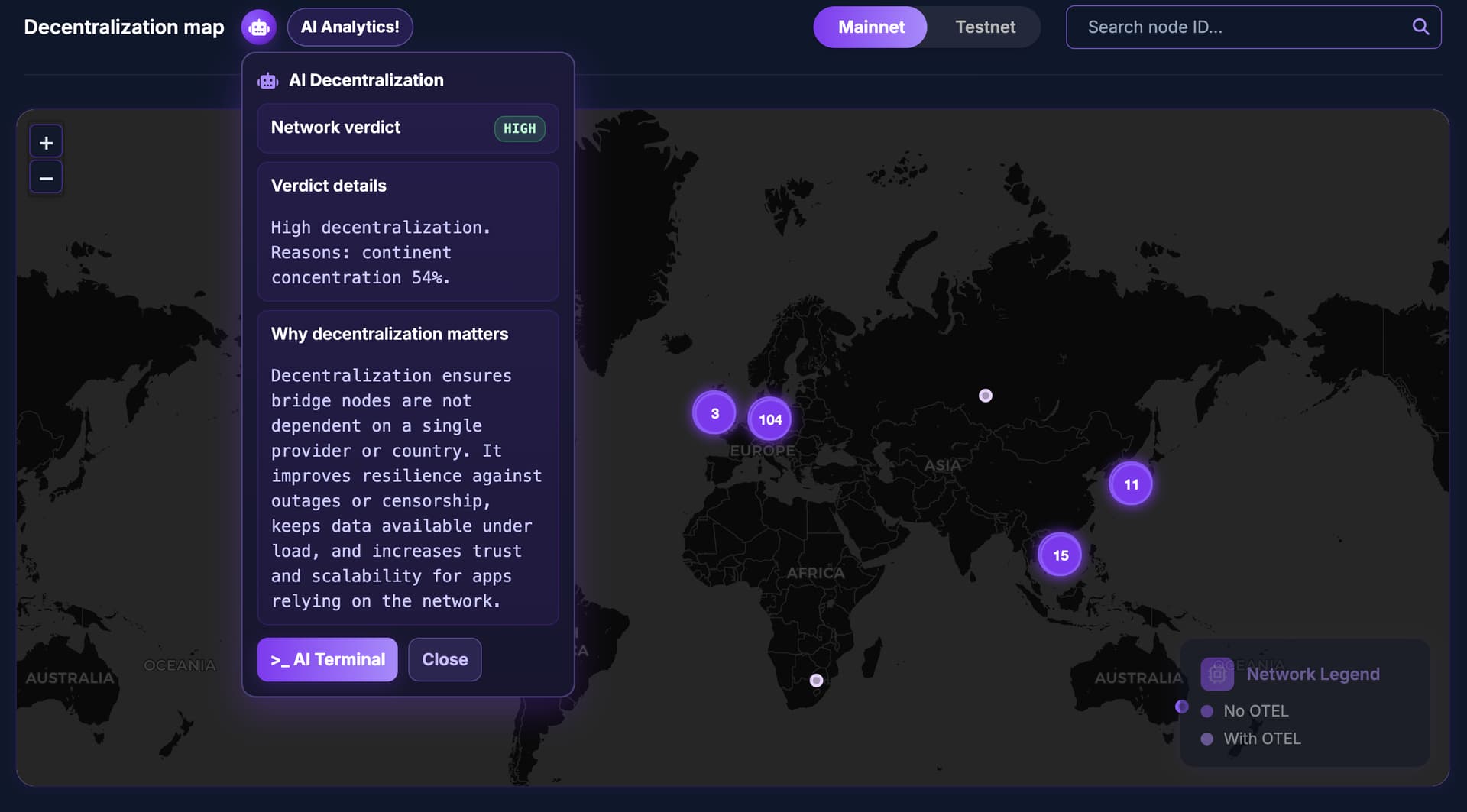
This module analyzes the distribution of bridge nodes across regions, providers, and continents.
CelestiaAI generates a Network Verdict (e.g., High / Medium / Low decentralization) along with a detailed explanation — such as “continent concentration: 54%.”
The interactive Decentralization Map visualizes node clusters worldwide, highlighting those with active OTEL telemetry and enabling quick assessment of global network resilience.
It also explains why decentralization matters — demonstrating how geographic and provider diversity strengthens fault tolerance and reduces the risks of censorship or outages.
2. AI Node Analytics & Anomaly Detection
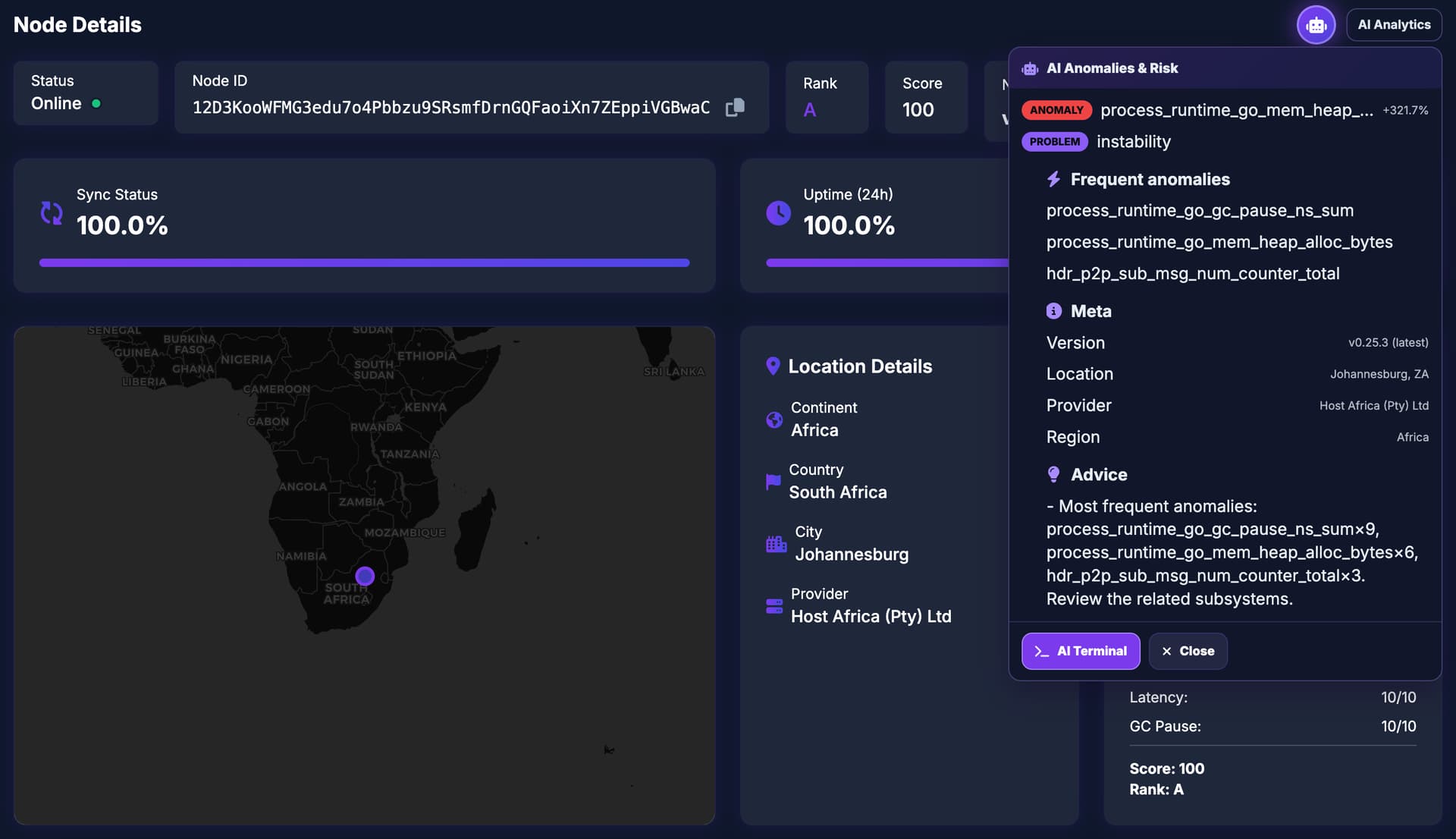
Each bridge node is continuously analyzed using live OTEL telemetry.
CelestiaAI detects anomalies and classifies them by risk severity, identifying metrics such as
process_runtime_go_gc_pause_ns_sum, hdr_store_head_height_gauge, and process_runtime_go_mem_heap_alloc_bytes.
The module provides:
• meta information (version, provider, location, uptime, region);
• performance scores and 24h uptime statistics;
• actionable AI-generated advice to resolve detected issues.
This transforms low-level telemetry into meaningful operational intelligence for node operators and ecosystem engineers.
3. AI Anomaly Tracking & Risk Dashboard
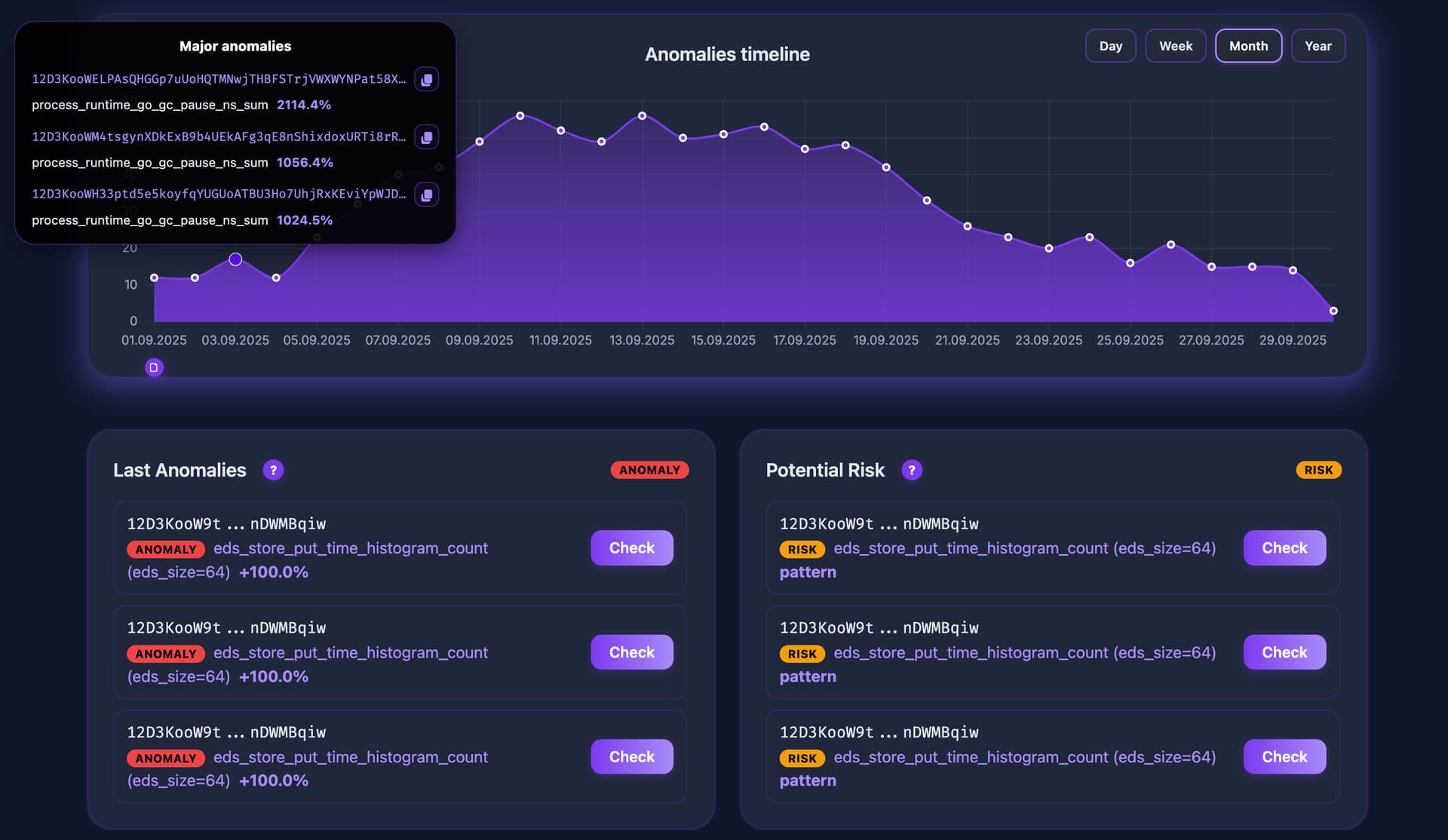
CelestiaAI maintains a complete record of detected anomalies and displays them on an interactive Anomalies Timeline, allowing users to monitor bridge node stability over daily, weekly, monthly, or yearly periods.
The system measures deviation levels, classifies anomalies by risk severity, and identifies recurring behavioral patterns.
The Risk Dashboard visualizes key metrics — deviation percentages, timestamps, and risk levels — while predicting potential failures to enable proactive network monitoring and maintain long-term stability.
 Open Source
The complete source code and MCP integration guide are publicly available on GitHub.
CelestiaUltraBot
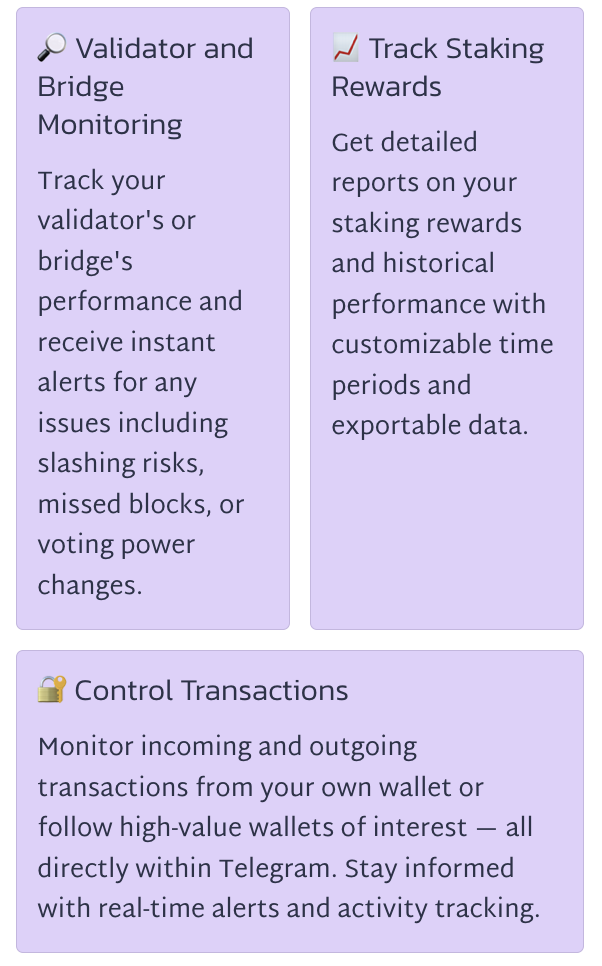
CelestiaUltraBot is your all-in-one Telegram assistant for the Celestia ecosystem — empowering validators, delegators, and enthusiasts with real-time monitoring, staking insights, and advanced tools, right at your fingertips
Other Contributions:
 Documentation
We create clear, accessible, and regularly updated resources for Celestia node operators.
• Comprehensive guides for validator, full, and archive nodes.
• Step-by-step instructions for staking, synchronization, and software upgrades.
• Validator checklists covering key management, monitoring, and slashing protection.
• Continuously maintained repositories and technical articles to support both new and experienced operators.

 Infrastructure Support
We operate a stable, multi-region infrastructure designed to support the Celestia community.
• Regularly updated snapshots for rapid node synchronization.
• Public RPC endpoints for dApps, explorers, and wallets.
• A full monitoring stack — Prometheus, Grafana, Alertmanager, and Loki — preconfigured for validator use.
• Geographically distributed data centers located in South Africa, the UAE, and South America to enhance network decentralization and reliability.

 Community Engagement & Education
We actively contribute to the Celestia ecosystem by sharing knowledge, developing tools, and supporting community members.
Our initiatives include:
• Publishing technical articles focused on validator security and operational best practices.
• Regularly sharing insights, tools, and educational materials on Medium, X, and GitBook.
• Operating a Telegram bot that provides validator alerts, reward tracking, and nominator tools.
• Offering mentorship and support within validator community channels to help new operators succeed.
Completed & Ongoing Contributions (Jan – Nov 2025)
January
 Selecting a data center with a unique geographic location and the required technical specifications
Daily archive snapshots for mainnet/testnet
Prometheus + Grafana monitoring stack
Validator setup checklist and staking guide
Launch of public RPC/gRPC/API nodes
February
Installation and testing of full node, validator node, and bridge node (mocha network)
Start of development of the Telegram bot CelestiaUltraBot v1.0 (tracking of the validator and wallet)
Telegram alerts CelestiaUltraBot: slashing, missed blocks, voting power + Twitter promotion (#1, #2, #3)
Internal scripts for collecting metrics via OTEL
Educational article on Medium about Celestia bridge + Twitter promotion
March
Telegram bot CelestiaUltraBot v2.0 (Monitoring the condition of bridges, introducing an AI assistant, tracking delegator rewards and validator commissions, etc.) + Twitter promotion
Preparation of detailed documentation on the use of the CelestiaUltraBot v2.0 + Twitter promotion #1, #2
Congratulations to Mammothon participants via X
CelestiaUltraBot Twitter Challenge (rules) + Twitter promotion #1, #2, #3
Telegram reports: APR, rewards, CSV
Other months
April
Start of development of the Celestia Bridge Explorer v1.0 (geo + IP mapping)
Configuring the IBC relayer Celestia with the Osmosis, Neutron, Elys and Injective networks (stats)
Study of CIP Celestia to make possible suggestions for improving the network
May
Grafana dashboards for bridge health
Improvements and new features added to CelestiaUltraBot
GitHub scripts: installation & updates for node/bridge (mainnet)
Continuation of development of Celestia Bridge Explorer v1.0 and addition of new features (upgrade history + OTEL snapshot)
June
Upgrade of Celestia Bridge Explorer to v2.0 with new features, including bridge node scoring based on performance, OTEL data visualization through dynamic charts, and tracking of average metrics across all bridge nodes
Design and development of Celestia Bridge Explorer for mobile devices
Collecting information about bridge nodes and their connection to validators
July
Presentation and overview of Celestia Bridge Explorer v2.0 (X and GitBook)
Opening a GitHub repository for collecting additional data about the bridge node and its associated validator
Preparation of materials and templates for publishing reports in X/Discord about software version updates, validator and bridge operator ratings, etc.
August
Expanding infrastructure and adding new regions for RPC, API and snapshots
Starting development of an AI assistant, including initial design drafts and architecture planning
Improving the Bridge Explorer, fixing bugs and optimizing performance
September
Continuing development of the AI assistant
Working on OTEL data analysis for bridge nodes
Monitoring bridge nodes upgrades and generating reports for the Bridge Explorer
October
Completion of AI assistant development
Design and implementation of the AI assistant terminal interface and UX
Integration of the AI assistant into the Bridge Explorer
November

 Launch of Celestia AI Assistant Terminal — explore on-chain metrics and bridge node performance using our own accumulated OTEL data repository. Gain analytical insights simply by asking natural-language questions, without any technical background required.
Launch of Bridge Explorer v3.0 — integration of CelestiaAI for advanced OTEL analytics of bridge nodes: anomaly and risk detection, data collection and interpretation for each bridge, automated evaluation of performance and stability, historical geolocation tracking, and more.
Launch of CelestiaUltraBot v3.0 — enhanced functionality with the addition of on-chain metrics and integration of CelestiaAI for real-time intelligent data analysis.
Why Choose VALIDEXIS
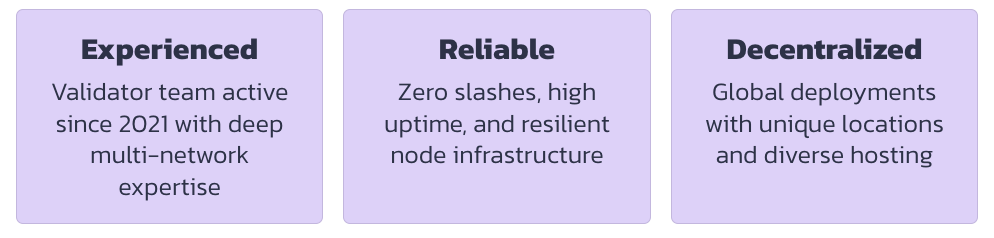
VALIDEXIS is a proven infrastructure team focused on reliability, decentralization, and long-term commitment to Celestia.
We operate globally distributed nodes, including one of the few mainnet bridge nodes in South Africa, helping strengthen network diversity and resilience.
Our validators maintain zero slashes, high uptime, and contribute actively to the ecosystem through public tools, documentation, and community support.
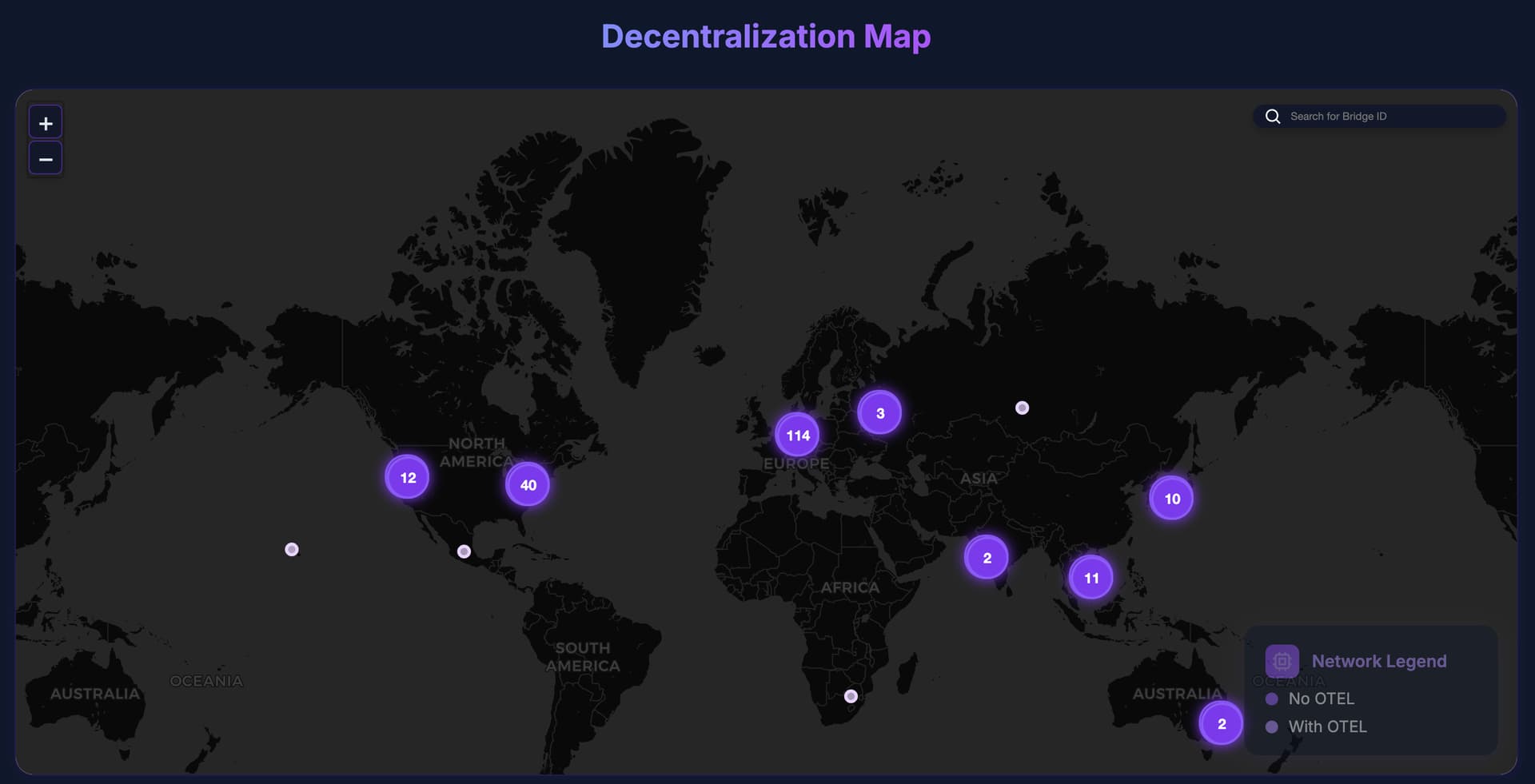
According to the Decentralization Map by VALIDEXIS, only 1 out of 205 Celestia bridge nodes is located in Africa (Johannesburg) — making up just ~0.5% of the total and highlighting it as one of the most underrepresented regions in the network.
By hosting our nodes in Cape Town, we actively support the geographic decentralization goals of the Celestia ecosystem.
VALIDEXIS is not just a validator — we are engineers, educators and ecosystem builders dedicated to decentralization and long-term reliability.
Website: https://validexis.com/
X: https://x.com/validexis
Docs: https://services.validexis.com/